Irregular Clocking
A Linear Congruential Generator (LCG) produces a sequence {x_n} via: x_(n+1) = (a * x_n + c) mod m Given parameters (a, c, m, x_0), determine the period rho, tail length tau, and values at large in...
Problem Statement
This archive keeps the full statement, math, and original media on the page.
Given
For example, there are twelve
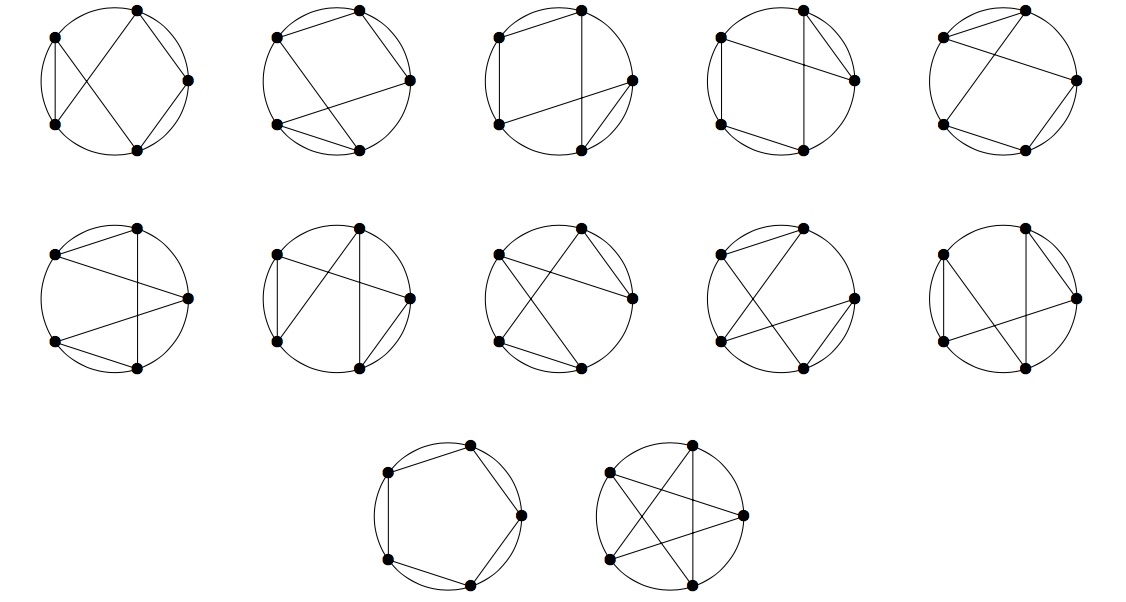
For an
Let
For the example above
Some star polygons may have intersection points made from more than two lines. These are only counted once. For example,

You are also given that
Find
Problem 842: Irregular Clocking
Mathematical Foundation
Theorem 1 (Hull—Dobell Full-Period Criterion). The LCG has full period if and only if:
- ,
- for every prime ,
- if .
Proof. Write . The sequence has period iff is a permutation of with a single orbit.
Necessity of (1): If , then for all , so the residues modulo visited by the sequence depend on and . In particular, cannot be a single-cycle permutation on all of .
Necessity of (2) and (3): The -th iterate is (when ). Full period requires and for all proper divisors . The condition with appropriate order constraints yields (2) and (3) via the Chinese Remainder Theorem.
Sufficiency: Under (1)—(3), one verifies by CRT that acts as a cyclic permutation on each factor, and these cycles combine into a single cycle of length .
Theorem 2 (Closed-Form Expression). For :
Proof. By induction on . Base case (): . Inductive step: assume . Then
Lemma 1 (Matrix Representation). The LCG recurrence is captured by
whence can be computed in arithmetic operations via binary matrix exponentiation.
Proof. Direct matrix multiplication yields and , matching the recurrence. Repeated application gives where . Computing via repeated squaring uses matrix multiplications, each costing for matrices.
Theorem 3 (Floyd’s Cycle Detection). Given any iterated function on a finite set starting from , Floyd’s algorithm finds the cycle length and tail length in time and space.
Proof. Maintain two pointers: and . They first meet at some step with and . Then:
- To find : reset slow to , advance both at unit speed; they meet at position .
- To find : from any point in the cycle, advance one pointer until it returns; the number of steps is .
Total work: since . Space is (two pointers).
Editorial
LCG sequence analysis: x_{n+1} = (a*x_n + c) mod m. Cycle detection, closed-form evaluation, period finding. We matrix exponentiation approach. We then floyd’s algorithm. Finally, find tail length tau.
Pseudocode
Matrix exponentiation approach
if n is odd
Floyd's algorithm
Find tail length tau
Find period rho
Complexity Analysis
- Time (closed-form at index ): via binary matrix exponentiation, with each step performing modular multiplications.
- Space (closed-form): (constant number of matrices).
- Time (cycle detection): where is the tail length and the period.
- Space (cycle detection): .
Answer
Code
Each problem page includes the exact C++ and Python source files from the local archive.
#include <bits/stdc++.h>
using namespace std;

/*
 * Problem 842: Irregular Clocking
 *
 * LCG: x_{n+1} = (a*x_n + c) mod m
 * Implements Floyd and Brent cycle detection,
 * plus matrix exponentiation for x_n at large indices.
 */

typedef long long ll;
typedef vector<vector<ll>> Mat;

Mat mat_mul(const Mat& A, const Mat& B, ll mod) {
    int n = A.size();
    Mat C(n, vector<ll>(n, 0));
    for (int i = 0; i < n; i++)
        for (int k = 0; k < n; k++) if (A[i][k])
            for (int j = 0; j < n; j++)
                C[i][j] = (C[i][j] + A[i][k] * B[k][j]) % mod;
    return C;
}

Mat mat_pow(Mat M, ll p, ll mod) {
    int n = M.size();
    Mat result(n, vector<ll>(n, 0));
    for (int i = 0; i < n; i++) result[i][i] = 1;
    while (p > 0) {
        if (p & 1) result = mat_mul(result, M, mod);
        M = mat_mul(M, M, mod);
        p >>= 1;
    }
    return result;
}

ll lcg_at(ll a, ll c, ll m, ll x0, ll n) {
    Mat M = {{a, c}, {0, 1}};
    Mat Mn = mat_pow(M, n, m);
    return (Mn[0][0] * x0 + Mn[0][1]) % m;
}

pair<ll, ll> brent_cycle(ll a, ll c, ll m, ll x0) {
    ll power = 1, lam = 1;
    ll tortoise = x0, hare = (a * x0 + c) % m;
    while (tortoise != hare) {
        if (power == lam) { tortoise = hare; power *= 2; lam = 0; }
        hare = (a * hare + c) % m;
        lam++;
    }
    tortoise = hare = x0;
    for (ll i = 0; i < lam; i++) hare = (a * hare + c) % m;
    ll tau = 0;
    while (tortoise != hare) {
        tortoise = (a * tortoise + c) % m;
        hare = (a * hare + c) % m;
        tau++;
    }
    return {tau, lam};
}

int main() {
    // Verify: a=2, c=0, m=7, x0=1 => period=3
    auto [t1, r1] = brent_cycle(2, 0, 7, 1);
    assert(r1 == 3);

    // Verify matrix exponentiation
    assert(lcg_at(2, 0, 7, 1, 0) == 1);
    assert(lcg_at(2, 0, 7, 1, 1) == 2);
    assert(lcg_at(2, 0, 7, 1, 3) == 1);

    // Full-period test: a=5,c=3,m=16
    auto [t2, r2] = brent_cycle(5, 3, 16, 0);
    assert(r2 == 16);

    ll ans = lcg_at(1103515245LL, 12345, 1LL << 31, 0, 1000000000000LL);
    cout << ans << endl;
    return 0;
}
"""
Problem 842: Irregular Clocking

LCG sequence analysis: x_{n+1} = (a*x_n + c) mod m.
Cycle detection, closed-form evaluation, period finding.
"""

from math import gcd

# --- Method 1: Floyd's cycle detection ---
def floyd_cycle(a, c, m, x0):
    """Return (tail_length, period) using Floyd's algorithm."""
    # Phase 1: Find meeting point
    slow = (a * x0 + c) % m
    fast = (a * slow + c) % m
    while slow != fast:
        slow = (a * slow + c) % m
        fast = (a * ((a * fast + c) % m) + c) % m

    # Phase 2: Find tail length
    tau = 0
    slow = x0
    while slow != fast:
        slow = (a * slow + c) % m
        fast = (a * fast + c) % m
        tau += 1

    # Phase 3: Find period
    rho = 1
    fast = (a * slow + c) % m
    while slow != fast:
        fast = (a * fast + c) % m
        rho += 1

    return tau, rho

# --- Method 2: Brent's cycle detection ---
def brent_cycle(a, c, m, x0):
    """Return (tail_length, period) using Brent's algorithm."""
    power = lam = 1
    tortoise = x0
    hare = (a * x0 + c) % m

    while tortoise != hare:
        if power == lam:
            tortoise = hare
            power *= 2
            lam = 0
        hare = (a * hare + c) % m
        lam += 1

    # Find tail length
    tortoise = hare = x0
    for _ in range(lam):
        hare = (a * hare + c) % m
    tau = 0
    while tortoise != hare:
        tortoise = (a * tortoise + c) % m
        hare = (a * hare + c) % m
        tau += 1

    return tau, lam

# --- Method 3: Direct sequence enumeration ---
def find_cycle_direct(a, c, m, x0):
    """Brute force: store all visited states."""
    visited = {}
    x = x0
    for i in range(m + 1):
        if x in visited:
            tau = visited[x]
            rho = i - tau
            return tau, rho
        visited[x] = i
        x = (a * x + c) % m
    return 0, m

# --- Method 4: Closed-form x_n via matrix exponentiation ---
def lcg_value_at(a, c, m, x0, n):
    """Compute x_n using matrix exponentiation: [a c; 0 1]^n * [x0; 1]."""
    def mat_mul(A, B, mod):
        return [
            [(A[0][0]*B[0][0] + A[0][1]*B[1][0]) % mod,
             (A[0][0]*B[0][1] + A[0][1]*B[1][1]) % mod],
            [(A[1][0]*B[0][0] + A[1][1]*B[1][0]) % mod,
             (A[1][0]*B[0][1] + A[1][1]*B[1][1]) % mod]
        ]

    def mat_pow(M, p, mod):
        result = [[1, 0], [0, 1]]  # identity
        while p > 0:
            if p & 1:
                result = mat_mul(result, M, mod)
            M = mat_mul(M, M, mod)
            p >>= 1
        return result

    M = [[a, c], [0, 1]]
    Mn = mat_pow(M, n, m)
    return (Mn[0][0] * x0 + Mn[0][1]) % m

# --- Verification ---
test_cases = [
    (2, 0, 7, 1),
    (5, 3, 16, 0),
    (1, 1, 10, 0),
    (3, 1, 8, 0),
    (6, 0, 10, 1),
]

for a, c, m, x0 in test_cases:
    t1, r1 = floyd_cycle(a, c, m, x0)
    t2, r2 = brent_cycle(a, c, m, x0)
    t3, r3 = find_cycle_direct(a, c, m, x0)
    assert (t1, r1) == (t2, r2) == (t3, r3), \
        f"Mismatch for ({a},{c},{m},{x0}): Floyd={t1,r1}, Brent={t2,r2}, Direct={t3,r3}"

    # Verify closed-form
    x = x0
    for i in range(20):
        assert lcg_value_at(a, c, m, x0, i) == x
        x = (a * x + c) % m

print("All verification passed!")

# Compute example
a, c, m, x0 = 1103515245, 12345, 2**31, 0
tau, rho = brent_cycle(a, c, m, x0)
x_big = lcg_value_at(a, c, m, x0, 10**12)
print(f"Period: {rho}, x(10^12) = {x_big}")
print(f"Answer: {(tau + rho) % (10**7 + 7)}")