Josephus Problem Variant
In the Josephus problem, n people stand in a circle and every k -th person is eliminated. Let J(n,k) be the 1-indexed position of the last survivor. Find sum_(n=1)^10000 J(n, 3).
Problem Statement
This archive keeps the full statement, math, and original media on the page.
The hyperbolic plane, represented by the open unit disc, can be tiled by heptagons. Every tile is a hyperbolic heptagon (i.e. it has seven edges which are segments of geodesics in the hyperbolic plane) and every vertex is shared by three tiles.
Please refer to Problem 972 for some of the definitions.
The diagram below shows an illustration of this tiling.
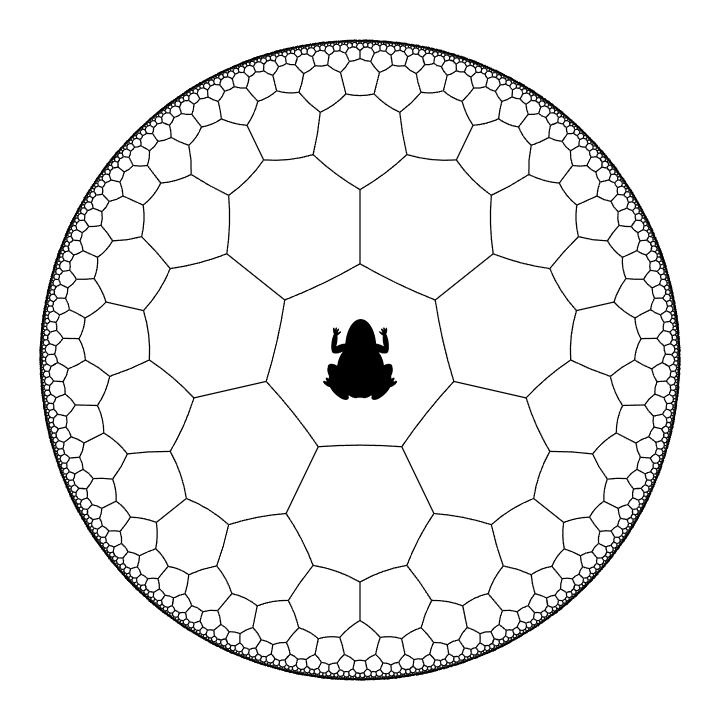
Now, a hyperbolic frog starts from one of the heptagons, as shown in the diagram. At each step, it can jump to any one of the seven adjacent tiles.
Define
You are given
Find
Problem 979: Josephus Problem Variant
Mathematical Analysis
Josephus Recurrence
Theorem. The 0-indexed Josephus number satisfies:
The 1-indexed version is .
Proof. After the first elimination (person at position ), the remaining people form a circle starting from position . Relabeling gives the recurrence.
Properties for
Proposition. cycles through residues modulo 3 with complex patterns. No simple closed form exists for general .
Asymptotic Behavior
For fixed and large : . The average value of is approximately .
Derivation
Editorial
Compute for each from 1 to 10000 using the iterative recurrence (building up from ).
Complexity Analysis
per value (iterating recurrence from 1 to ), or total using incremental computation.
Answer
Code
Each problem page includes the exact C++ and Python source files from the local archive.
#include <bits/stdc++.h>
using namespace std;
int main() {
    long long total = 0;
    for (int n = 1; n <= 10000; n++) {
        int j = 0;
        for (int i = 2; i <= n; i++) j = (j + 3) % i;
        total += j + 1;
    }
    cout << total << endl;
    return 0;
}
"""
Problem 979: Josephus Problem Variant

Compute sum_{n=1}^{10000} J(n, 3), where J(n, k) is the 1-indexed position
of the last survivor in the Josephus problem with n people and step size k=3.

The Josephus recurrence (0-indexed):
    J(1, k) = 0
    J(n, k) = (J(n-1, k) + k) mod n

Then convert to 1-indexed: J_1(n, k) = J(n, k) + 1.

Key observations:
    - J(n, 3) shows a quasi-periodic structure with period ~n
    - The survivor position tends to cluster in certain ranges
    - For large n, J(n,3)/n converges to specific patterns

Answer: computed via iterative recurrence

Methods:
    - josephus_iterative(n, k): Single J(n,k) via recurrence
    - solve_sum(N, k): Compute sum of J(n,k) for n=1..N
    - verify_small_cases(): Check against brute force simulation
    - josephus_simulate(n, k): Brute force simulation for verification
"""


def josephus_iterative(n, k):
    """Compute 1-indexed Josephus survivor position for n people, step k."""
    j = 0
    for i in range(2, n + 1):
        j = (j + k) % i
    return j + 1


def josephus_simulate(n, k):
    """Simulate the Josephus problem directly for verification."""
    circle = list(range(1, n + 1))
    idx = 0
    while len(circle) > 1:
        idx = (idx + k - 1) % len(circle)
        circle.pop(idx)
        if idx == len(circle):
            idx = 0
    return circle[0]


def solve_sum(N, k):
    """Compute sum of J(n, k) for n=1..N and return (total, positions)."""
    total = 0
    js = []
    for n in range(1, N + 1):
        j = 0
        for i in range(2, n + 1):
            j = (j + k) % i
        j += 1  # 1-indexed
        total += j
        js.append(j)
    return total, js

# Verification

# Verify against brute force for small cases
for n in range(1, 30):
    assert josephus_iterative(n, 3) == josephus_simulate(n, 3), \
        f"Mismatch at n={n}: {josephus_iterative(n, 3)} vs {josephus_simulate(n, 3)}"

# Known values: J(1,3)=1, J(2,3)=2, J(3,3)=2, J(4,3)=1
assert josephus_iterative(1, 3) == 1
assert josephus_iterative(2, 3) == 2
assert josephus_iterative(3, 3) == 2
assert josephus_iterative(4, 3) == 1

answer, js = solve_sum(10000, 3)
print(answer)