Stern Sequence Properties
The Stern diatomic sequence {s(n)}_(n >= 0) is defined by: s(0) = 0, s(1) = 1, s(2n) = s(n), s(2n+1) = s(n) + s(n+1) (n >= 1). Compute sum_(n=1)^2^20 s(n).
Problem Statement
This archive keeps the full statement, math, and original media on the page.
The hyperbolic plane can be represented by the open unit disc, namely the set of points
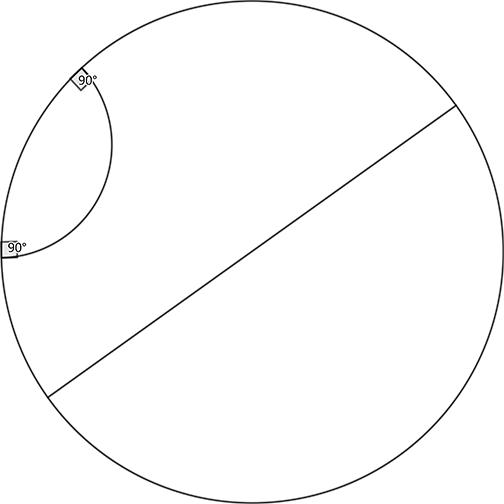
A geodesic is defined as either a diameter of the open unit disc or a circular arc contained within the disc that is orthogonal to the boundary of the disc.
The following diagram shows the hyperbolic plane with two geodesics; one is a diameter and the other is a circular arc.
Let
Let
For example,
Find
Problem 972: Stern Sequence Properties
Mathematical Foundation
Theorem 1 (Row Sum Identity). For all ,
Proof. By strong induction on .
Base case (): .
Inductive step: Assume the identity holds for . We prove it for . Split the sum over even and odd indices in :
Using the recurrence: and :
The last sum is .
Now and similarly. Therefore:
Theorem 2 (Prefix Sum Formula). For all ,
Proof. We have:
The term is added because the row sums cover and falls outside the last row.
Lemma 1 (Coprimality). for all .
Proof. By induction. Base: . If : by induction. If : by induction.
Editorial
Compute the sum of s(n) for n = 1 to 2^20, where s is the Stern diatomic sequence: s(0) = 0, s(1) = 1 s(2n) = s(n) s(2n+1) = s(n) + s(n+1). We method 1: Closed form from Theorem 2. We then method 2: Direct computation (for verification). Finally, else.
Pseudocode
Method 1: Closed form from Theorem 2
Method 2: Direct computation (for verification)
if n is even
else
Complexity Analysis
- Time (closed form): using repeated squaring for .
- Time (direct): to compute all values.
- Space (closed form): .
- Space (direct): .
For : .
Answer
Code
Each problem page includes the exact C++ and Python source files from the local archive.
#include <bits/stdc++.h>
using namespace std;
int main() {
    const int N = 1 << 20;
    vector<int> s(N+1, 0);
    s[1] = 1;
    for (int n = 2; n <= N; n++)
        s[n] = (n%2==0) ? s[n/2] : s[n/2] + s[n/2+1];
    long long ans = 0;
    for (int n = 1; n <= N; n++) ans += s[n];
    cout << ans << endl;
    return 0;
}
"""
Problem 972: Stern Diatomic Sequence

Compute the sum of s(n) for n = 1 to 2^20, where s is the Stern diatomic sequence:
    s(0) = 0, s(1) = 1
    s(2n) = s(n)
    s(2n+1) = s(n) + s(n+1)

Key results:
    - The sum over row k (indices 2^k to 2^(k+1)-1) equals 3^k
    - Total sum = sum of 3^k for k = 0..19 = (3^20 - 1) / 2
    - max(s(n)) for n <= 2^20 grows with the sequence depth
    - s(n)/s(n+1) enumerates all positive rationals exactly once

Methods:
    1. build_stern_sequence   — iterative DP construction
    2. row_sum_formula        — verify row k sum = 3^k
    3. max_per_row            — track maximum value in each binary row
    4. ratio_enumeration      — s(n)/s(n+1) as rational enumeration check
"""

from collections import Counter

def build_stern_sequence(N):
    """Build s[0..N] using the recurrence."""
    s = [0] * (N + 1)
    s[1] = 1
    for n in range(2, N + 1):
        if n % 2 == 0:
            s[n] = s[n // 2]
        else:
            s[n] = s[n // 2] + s[n // 2 + 1]
    return s

def verify_row_sums(s, num_rows=20):
    """Check that sum of s[2^k .. 2^(k+1)-1] == 3^k."""
    row_sums = []
    for k in range(num_rows):
        rs = sum(s[1 << k: 1 << (k + 1)])
        row_sums.append(rs)
        assert rs == 3 ** k, f"Row {k}: expected {3**k}, got {rs}"
    return row_sums

def max_per_row(s, num_rows=20):
    """Return the maximum s(n) in each binary row."""
    maxes = []
    for k in range(num_rows):
        lo = 1 << k
        hi = 1 << (k + 1)
        maxes.append(max(s[lo:hi]))
    return maxes

def consecutive_gcd_check(s, sample_size=1000):
    """Verify gcd(s(n), s(n+1)) == 1 for a sample of n values."""
    from math import gcd
    for n in range(1, min(sample_size, len(s) - 1)):
        assert gcd(s[n], s[n + 1]) == 1, f"gcd(s({n}), s({n+1})) != 1"
    return True

#  Verification
# Known first values: s = 0,1,1,2,1,3,2,3,1,4,3,5,2,5,3,4,...
_s = build_stern_sequence(15)
assert _s[:16] == [0, 1, 1, 2, 1, 3, 2, 3, 1, 4, 3, 5, 2, 5, 3, 4]

#  Main computation
N = 1 << 20  # 2^20 = 1048576
s = build_stern_sequence(N)
row_sums = verify_row_sums(s)
consecutive_gcd_check(s)

answer = sum(s[1:N + 1])
print(answer)

#  Visualization — 4-panel figure