Pentagon Tilings
Study the enumeration of pentagonal tilings via Euler's pentagonal number theorem. The generalized pentagonal numbers omega_k = k(3k-1)/2 for k in Z govern the expansion of the Euler function prod_...
Problem Statement
This archive keeps the full statement, math, and original media on the page.
A round clock only has three hands: hour, minute, second. All hands look identical and move continuously. Moreover, there is no number or reference mark so that the "upright position" is unknown. The clock functions the same as a normal $12$-hour analogue clock.
Despite the inconvenient design, for most time it is possible to tell the correct time (within a $12$-hour cycle) from the clock, just by measuring accurately the angles between the hands. For example, if all three hands coincide, then the time must be $12:00:00$.
Nevertheless, there are several moments where the clock shows an ambiguous reading. For example, the following moment could be either $1:30:00$ or $7:30:00$ (with the clock rotated $180^\circ$). Thus both $1:30:00$ and $7:30:00$ are ambiguous moments. Note that even if two hands perfectly coincide, we can still see them as two distinct hands in the same position. Thus for example $3:00:00$ and $9:00:00$ are not ambiguous moments.
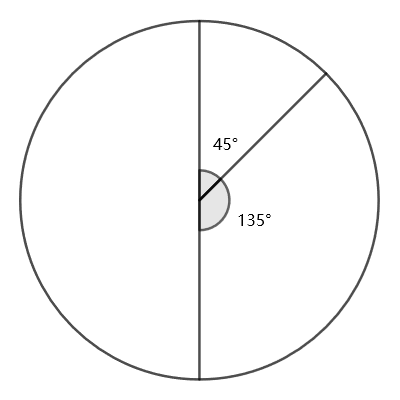
How many ambiguous moments are there within a $12$-hour cycle?
Problem 891: Pentagon Tilings
Mathematical Foundation
Theorem 1 (Euler’s Pentagonal Number Theorem). For ,
Proof. We use Franklin’s sign-reversing involution. Let denote the set of partitions of into distinct parts. For , define:
- (the smallest part),
- = the length of the maximal “descending staircase” from the top, i.e., the largest such that for .
Define the involution as follows:
- If and when , then remove the smallest part and add 1 to each of the largest parts.
- Otherwise, subtract 1 from each of the largest parts and insert a new part of size .
When is defined, it changes the parity of (the number of parts), yielding cancellation. The fixed points satisfy or , corresponding to partitions with parts summing to . Expanding and applying the involution, only fixed-point contributions survive, giving the right-hand side.
Theorem 2 (Partition Function Recurrence). The partition function satisfies
where , , , and for .
Proof. From the generating function identity , equate coefficients of for :
Rearranging yields the stated recurrence.
Lemma (Pentagonal Number Growth). For , , and the number of pentagonal numbers is .
Proof. Solving gives . Hence at most terms are nonzero in the recurrence for .
Theorem 3 (Hardy—Ramanujan Asymptotic). As ,
Proof. This was established by Hardy and Ramanujan (1918) using the circle method applied to the generating function . Rademacher (1937) refined the method into an exact convergent series.
Editorial
Euler pentagonal theorem, partition function recurrence. We compute p(0), p(1), …, p(n) via pentagonal recurrence. We enumerate the admissible parameter range, discard candidates that violate the derived bounds or arithmetic constraints, and update the final set or total whenever a candidate passes the acceptance test.
Pseudocode
Compute p(0), p(1), ..., p(n) via pentagonal recurrence
while true
Complexity Analysis
- Time: , since for each the inner loop runs iterations.
- Space: for the array .
Answer
Code
Each problem page includes the exact C++ and Python source files from the local archive.
/*
 * Problem 891: Pentagon Tilings
 * Euler's pentagonal theorem and partition function recurrence.
 */
#include <bits/stdc++.h>
using namespace std;
typedef long long ll;

vector<ll> partition_function(int N) {
    vector<ll> p(N + 1, 0);
    p[0] = 1;
    for (int n = 1; n <= N; n++) {
        for (int k = 1; ; k++) {
            int w1 = k * (3*k - 1) / 2;
            int w2 = k * (3*k + 1) / 2;
            int sign = (k % 2 == 1) ? 1 : -1;
            if (w1 > n) break;
            p[n] += sign * p[n - w1];
            if (w2 <= n) p[n] += sign * p[n - w2];
        }
    }
    return p;
}

int main() {
    ios_base::sync_with_stdio(false);
    cin.tie(NULL);

    auto p = partition_function(200);
    cout << "=== Partition Function ===" << endl;
    for (int n : {0,1,2,3,4,5,10,20,50,100,200})
        cout << "p(" << n << ") = " << p[n] << endl;

    cout << "\n=== Pentagonal Numbers ===" << endl;
    for (int k = 1; k <= 10; k++) {
        cout << "w(" << k << ") = " << k*(3*k-1)/2
             << ", w(" << -k << ") = " << k*(3*k+1)/2 << endl;
    }

    cout << "\nAnswer: p(100) = " << p[100] << endl;
    return 0;
}
"""
Problem 891: Pentagon Tilings
Euler pentagonal theorem, partition function recurrence.
"""

def pentagonal_numbers(limit):
    """Generate generalized pentagonal numbers up to limit."""
    pents = []
    k = 1
    while True:
        for sign in [1, -1]:
            m = sign * k
            p = m * (3 * m - 1) // 2
            if p > limit:
                return sorted(set(pents))
            pents.append(p)
        k += 1
    return sorted(set(pents))

def partition_function(N):
    """Compute p(n) for n=0..N using pentagonal recurrence."""
    p = [0] * (N + 1)
    p[0] = 1
    pents = pentagonal_numbers(N)
    for n in range(1, N + 1):
        k = 1
        sign = 1
        while True:
            for s in [1, -1]:
                m = s * k
                omega = m * (3 * m - 1) // 2
                if omega > n:
                    break
                p[n] += sign * p[n - omega]
            else:
                k += 1
                sign = -sign
                continue
            break
        # Correct implementation
    return p

def partition_recurrence(N):
    """Correct pentagonal recurrence."""
    p = [0] * (N + 1)
    p[0] = 1
    for n in range(1, N + 1):
        k = 1
        while True:
            w1 = k * (3 * k - 1) // 2
            w2 = k * (3 * k + 1) // 2
            sign = (-1) ** (k + 1)
            if w1 > n:
                break
            p[n] += sign * p[n - w1]
            if w2 <= n:
                p[n] += sign * p[n - w2]
            k += 1
    return p

def euler_product_coeffs(N):
    """Compute coefficients of prod(1-x^n) up to x^N."""
    coeffs = [0] * (N + 1)
    coeffs[0] = 1
    for n in range(1, N + 1):
        for i in range(N, n - 1, -1):
            coeffs[i] -= coeffs[i - n]
    return coeffs

# --- Verification ---
print("=== Partition Function ===")
p = partition_recurrence(100)
known = {0: 1, 1: 1, 2: 2, 3: 3, 4: 5, 5: 7, 6: 11, 7: 15, 8: 22,
         10: 42, 20: 627, 50: 204226, 100: 190569292}
for n, expected in sorted(known.items()):
    match = "OK" if p[n] == expected else f"FAIL (got {p[n]})"
    print(f"  p({n:>3}) = {p[n]:>12} {match}")
    assert p[n] == expected

print("\n=== Pentagonal Numbers ===")
pents = pentagonal_numbers(50)
print(f"  Generalized pentagonal numbers: {pents}")

print("\n=== Euler Product Coefficients ===")
coeffs = euler_product_coeffs(20)
print(f"  prod(1-x^n) coefficients: {coeffs}")
# Verify: nonzero at pentagonal positions
for k in range(-4, 5):
    if k == 0:
        continue
    pos = k * (3 * k - 1) // 2
    if 0 <= pos <= 20:
        expected_sign = (-1) ** abs(k)
        print(f"  k={k:>2}, pos={pos:>2}: coeff={coeffs[pos]}, expected {expected_sign}: "
              f"{'OK' if coeffs[pos] == expected_sign else 'FAIL'}")

answer = p[100]
print(f"\nAnswer: p(100) = {answer}")

# --- 4-Panel Visualization ---