Lissajous Curves
For coprime positive integers a and b, define the curve x=cos(at), y=cos (b(t-(pi)/(10))), 0 <= t <= 2pi. Let d(a,b) be the sum of x^2+y^2 over all self-intersection points of the curve, and let s(...
Problem Statement
This archive keeps the full statement, math, and original media on the page.
For coprime positive integers \(a\) and \(b\), let \(C_{a,b}\) be the curve defined by: \[ \begin {cases} x = \cos \left (at\right ) \\ y = \cos \left (b\left (t-\frac {\pi }{10}\right )\right ) \end {cases} \] where \(t\) varies between 0 and \(2\pi \).
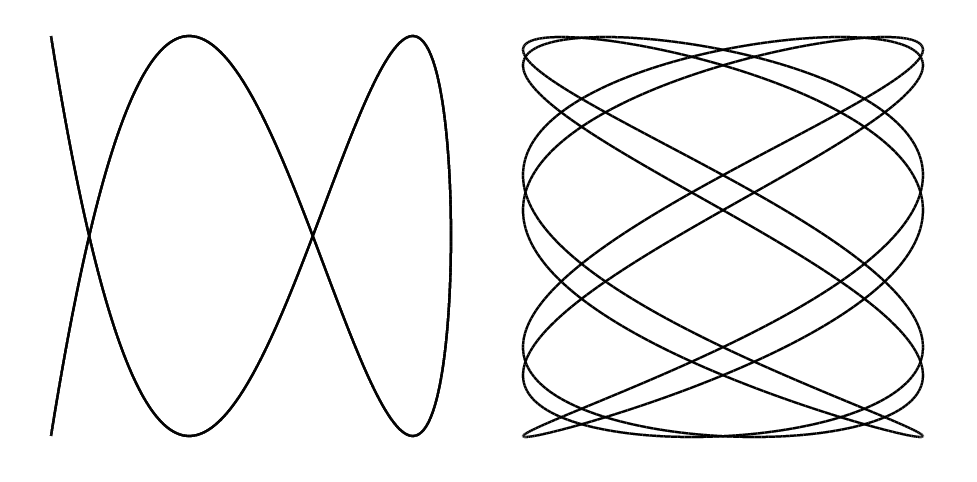
For example, the images below show \(C_{2,5}\) (left) and \(C_{7,4}\) (right):
Define \(d(a,b) = \displaystyle \sum (x^2 + y^2)\), where the sum is over all points \((x, y)\) at which \(C_{a,b}\) crosses itself.
For example, in the case of \(C_{2,5}\) illustrated above, the curve crosses itself at two points: \((0.31, 0)\) and \((-0.81, 0)\), rounding coordinates to two decimal places, yielding \(d(2, 5)=0.75\). Some other examples are \(d(2,3)=4.5\), \(d(7,4)=39.5\), \(d(7,5)=52\), and \(d(10,7)=23.25\).
Let \(s(m) = \displaystyle \sum d(a,b)\), where this sum is over all pairs of coprime integers \(a,b\) with \(2\le a\le m\) and \(2\le b\le m\).
You are given that \(s(10) = 1602.5\) and \(s(100) = 24256505\).
Find \(s(10^6)\). Give your answer in scientific notation rounded to \(10\) significant digits; for example \(s(100)\) would be given as \(2.425650500e7\).
Problem 777: Lissajous Curves
1. When Do Two Parameters Give the Same Point?
Suppose t_1 != t_2 and the curve takes the same value at both parameters. Since
we must have
The (+,+) case gives t_1 \equiv t_2 (mod 2\pi) because gcd(a,b)=1, so it is trivial.
The two nontrivial cases are therefore:
Case B
Case C
The (-,-) case will matter only when the whole curve is retraced; that happens exactly when 10 | ab.
2. Coordinates of the Candidate Intersections
Let m,n be the integers from Cases B and C.
For Case B, after solving for t_1,t_2 and simplifying, the point satisfies
Because gcd(a,b)=1, multiplication by a permutes residues modulo b, and multiplication by b permutes residues modulo a. Hence the Case-B contributions are exactly
and
Similarly, Case C gives
and
3. Which Repeated Points Are Genuine Crossings?
Different parameter values can also describe the same local branch, which does not count as a crossing.
In Case B the two tangent vectors are
while in Case C they are
So a repeated point is a genuine crossing exactly when neither derivative component vanishes, i.e.
This is the only exclusion we need.
4. Formula for d(a,b)
4.1 The Generic Case 10 ∤ ab
If 10 ∤ ab, then the curve is not retraced, and every valid Case-B or Case-C point is counted exactly once.
Using
we get
and
Therefore
4.2 The Retraced Case 10 | ab
If 10 | ab, the omitted (-,-) congruence has a solution, so the whole curve is traced twice. Then every non-tangential crossing coming from Cases B and C is counted four times in the raw parameter count.
The only tangential raw points are the ones with x^2=1 in Case B and the ones with y^2=1 in Case C. Their raw total is
So
Hence:
This matches all examples in the statement.
5. Reducing s(m) to Arithmetic Sums
Let, over coprime pairs 2 <= a,b <= m,
Let C_{10}, A_{10}, M_{10} be the same sums restricted to 10 | ab.
Because the summation is symmetric in a and b, we also have \sum b = A.
From the formula for d(a,b) above,
So it remains to compute these six arithmetic totals.
6. Möbius Inversion
For any filter P(n), define:
c_P(d)= number ofn <= msuch thatd | nandP(n)holds,s_P(d)= sum of thosen.
Then over 1 <= a,b <= m,
After computing these on 1 <= a,b <= m, we subtract the boundary pairs with a=1 or b=1, because the problem starts at 2.
We use four filters:
alloddnon5= numbers not divisible by5coprime10= numbers coprime to10
Their c_P(d) and s_P(d) are closed-form:
all: plain counts and arithmetic sums of multiples ofdodd: only odd multiples ofdnon5: multiples ofdexcluding those divisible by5coprime10: odd multiples ofdexcluding odd multiples of5
Finally,
so
for each of X in {C,A,M}.
This yields s(m) in O(m) time after a linear sieve for \mu.
Correctness
Theorem. The algorithm returns the correct value of s(m).
Proof. Sections 1 through 4 prove the exact closed form for d(a,b), separating the cases 10 \nmid ab and 10 \mid ab. Section 5 rewrites s(m) in terms of the six arithmetic totals C, A, M, C_{10}, A_{10}, M_{10}. Section 6 computes each of these exactly by Möbius inversion together with inclusion-exclusion for the condition 10 \mid ab. Therefore every summand is exact, so the final value of s(m) is exact as well.
7. Complexity Analysis
- Möbius sieve:
O(m) - The four filtered divisor sums:
O(m) - Memory:
O(m)
For m = 10^6, this is easily feasible.
Answer
The computation gives
Code
Each problem page includes the exact C++ and Python source files from the local archive.
#include <cmath>
#include <cassert>
#include <iomanip>
#include <iostream>
#include <sstream>
#include <string>
#include <vector>

namespace {

constexpr int TARGET = 1'000'000;
const std::string TARGET_ANSWER = "2.533018434e23";

using i128 = __int128_t;

struct Stats {
    i128 count;
    i128 sum_first;
    i128 sum_product;
};

i128 triangular(i128 n) {
    return n * (n + 1) / 2;
}

std::vector<int> mobius_sieve(int limit) {
    std::vector<int> mu(limit + 1);
    std::vector<int> primes;
    std::vector<bool> composite(limit + 1, false);
    mu[1] = 1;

    for (int value = 2; value <= limit; ++value) {
        if (!composite[value]) {
            primes.push_back(value);
            mu[value] = -1;
        }
        for (int prime : primes) {
            long long next = 1LL * value * prime;
            if (next > limit) {
                break;
            }
            composite[static_cast<int>(next)] = true;
            if (value % prime == 0) {
                mu[static_cast<int>(next)] = 0;
                break;
            }
            mu[static_cast<int>(next)] = -mu[value];
        }
    }

    return mu;
}

std::pair<i128, i128> count_and_sum(const std::string& filter_name, int limit, int divisor) {
    const i128 n = limit / divisor;

    if (filter_name == "all") {
        return {n, static_cast<i128>(divisor) * triangular(n)};
    }

    if (filter_name == "odd") {
        if (divisor % 2 == 0) {
            return {0, 0};
        }
        const i128 odd_count = (n + 1) / 2;
        return {odd_count, static_cast<i128>(divisor) * odd_count * odd_count};
    }

    if (filter_name == "non5") {
        if (divisor % 5 == 0) {
            return {0, 0};
        }
        return {
            n - n / 5,
            static_cast<i128>(divisor) * (triangular(n) - 5 * triangular(n / 5)),
        };
    }

    if (filter_name == "coprime10") {
        if (divisor % 2 == 0 || divisor % 5 == 0) {
            return {0, 0};
        }
        const i128 odd_count = (n + 1) / 2;
        const i128 odd_multiple_5_count = (n / 5 + 1) / 2;
        const i128 count = odd_count - odd_multiple_5_count;
        const i128 total =
            static_cast<i128>(divisor)
            * (odd_count * odd_count - 5 * odd_multiple_5_count * odd_multiple_5_count);
        return {count, total};
    }

    assert(false && "unknown filter");
    return {0, 0};
}

Stats pair_stats(int limit, const std::string& filter_name, const std::vector<int>& mu) {
    i128 count_full = 0;
    i128 sum_first_full = 0;
    i128 sum_product_full = 0;

    for (int divisor = 1; divisor <= limit; ++divisor) {
        const int mobius = mu[divisor];
        if (mobius == 0) {
            continue;
        }
        const auto [count, total] = count_and_sum(filter_name, limit, divisor);
        if (count == 0) {
            continue;
        }
        count_full += static_cast<i128>(mobius) * count * count;
        sum_first_full += static_cast<i128>(mobius) * total * count;
        sum_product_full += static_cast<i128>(mobius) * total * total;
    }

    const auto [total_count, total_sum] = count_and_sum(filter_name, limit, 1);
    return {
        count_full - (2 * total_count - 1),
        sum_first_full - (total_count + total_sum - 1),
        sum_product_full - (2 * total_sum - 1),
    };
}

i128 solve_quarters(int limit = TARGET) {
    const std::vector<int> mu = mobius_sieve(limit);

    const Stats all_stats = pair_stats(limit, "all", mu);
    const Stats odd_stats = pair_stats(limit, "odd", mu);
    const Stats non5_stats = pair_stats(limit, "non5", mu);
    const Stats coprime10_stats = pair_stats(limit, "coprime10", mu);

    const i128 count_10 = all_stats.count - odd_stats.count - non5_stats.count
                        + coprime10_stats.count;
    const i128 sum_first_10 = all_stats.sum_first - odd_stats.sum_first - non5_stats.sum_first
                            + coprime10_stats.sum_first;
    const i128 sum_product_10 =
        all_stats.sum_product - odd_stats.sum_product - non5_stats.sum_product
        + coprime10_stats.sum_product;

    return 8 * all_stats.sum_product
         - 12 * all_stats.sum_first
         + 4 * count_10
         - 6 * sum_product_10
         + 6 * sum_first_10;
}

long double to_long_double(i128 value) {
    return static_cast<long double>(value);
}

long double d_formula(int a, int b) {
    if ((1LL * a * b) % 10 == 0) {
        return static_cast<long double>(2LL * a * b - 3LL * a - 3LL * b + 4) / 4.0L;
    }
    return static_cast<long double>(4LL * a * b - 3LL * a - 3LL * b) / 2.0L;
}

long double brute_sum(int limit) {
    long double total = 0.0L;
    for (int a = 2; a <= limit; ++a) {
        for (int b = 2; b <= limit; ++b) {
            int x = a;
            int y = b;
            while (y != 0) {
                const int temp = x % y;
                x = y;
                y = temp;
            }
            if (x == 1) {
                total += d_formula(a, b);
            }
        }
    }
    return total;
}

std::string format_quarters(i128 quarters, int digits_after_decimal = 9) {
    const long double value = to_long_double(quarters) / 4.0L;
    std::ostringstream out;
    out << std::scientific << std::setprecision(digits_after_decimal) << value;
    const std::string text = out.str();
    const std::size_t split = text.find('e');
    const std::string mantissa = text.substr(0, split);
    const int exponent = std::stoi(text.substr(split + 1));
    return mantissa + "e" + std::to_string(exponent);
}

bool nearly_equal(long double a, long double b, long double eps = 1e-12L) {
    return fabsl(a - b) <= eps;
}

void self_test() {
    assert(nearly_equal(d_formula(2, 3), 4.5L));
    assert(nearly_equal(d_formula(2, 5), 0.75L));
    assert(nearly_equal(d_formula(7, 4), 39.5L));
    assert(nearly_equal(d_formula(7, 5), 52.0L));
    assert(nearly_equal(d_formula(10, 7), 23.25L));

    for (int limit : {3, 4, 5, 10, 20}) {
        assert(nearly_equal(to_long_double(solve_quarters(limit)) / 4.0L, brute_sum(limit)));
    }

    assert(solve_quarters(10) == static_cast<i128>(6410));
    assert(solve_quarters(100) == static_cast<i128>(97026020));
    assert(format_quarters(solve_quarters()) == TARGET_ANSWER);
}

}  // namespace

int main() {
    self_test();
    std::cout << format_quarters(solve_quarters()) << '\n';
    return 0;
}
"""Project Euler 777: Lissajous Curves."""

from __future__ import annotations

from dataclasses import dataclass
from decimal import Decimal, localcontext
from math import gcd, pi

TARGET = 10**6
TARGET_ANSWER = "2.533018434e23"


def mobius_sieve(limit: int) -> list[int]:
    mu = [0] * (limit + 1)
    mu[1] = 1
    primes: list[int] = []
    composite = [False] * (limit + 1)
    for value in range(2, limit + 1):
        if not composite[value]:
            primes.append(value)
            mu[value] = -1
        for prime in primes:
            nxt = value * prime
            if nxt > limit:
                break
            composite[nxt] = True
            if value % prime == 0:
                mu[nxt] = 0
                break
            mu[nxt] = -mu[value]
    return mu


def triangular(n: int) -> int:
    return n * (n + 1) // 2


@dataclass(frozen=True)
class Stats:
    count: int
    sum_first: int
    sum_product: int


def count_and_sum(filter_name: str, limit: int, divisor: int) -> tuple[int, int]:
    n = limit // divisor

    if filter_name == "all":
        return n, divisor * triangular(n)

    if filter_name == "odd":
        if divisor % 2 == 0:
            return 0, 0
        odd_count = (n + 1) // 2
        return odd_count, divisor * odd_count * odd_count

    if filter_name == "non5":
        if divisor % 5 == 0:
            return 0, 0
        return n - n // 5, divisor * (triangular(n) - 5 * triangular(n // 5))

    if filter_name == "coprime10":
        if divisor % 2 == 0 or divisor % 5 == 0:
            return 0, 0
        odd_count = (n + 1) // 2
        odd_multiple_5_count = ((n // 5) + 1) // 2
        count = odd_count - odd_multiple_5_count
        total = divisor * (
            odd_count * odd_count - 5 * odd_multiple_5_count * odd_multiple_5_count
        )
        return count, total

    raise ValueError(f"Unknown filter: {filter_name}")


def pair_stats(limit: int, filter_name: str, mu: list[int]) -> Stats:
    count_full = 0
    sum_first_full = 0
    sum_product_full = 0

    for divisor in range(1, limit + 1):
        mobius = mu[divisor]
        if mobius == 0:
            continue
        count, total = count_and_sum(filter_name, limit, divisor)
        if count == 0:
            continue
        count_full += mobius * count * count
        sum_first_full += mobius * total * count
        sum_product_full += mobius * total * total

    total_count, total_sum = count_and_sum(filter_name, limit, 1)
    return Stats(
        count=count_full - (2 * total_count - 1),
        sum_first=sum_first_full - (total_count + total_sum - 1),
        sum_product=sum_product_full - (2 * total_sum - 1),
    )


def solve_quarters(limit: int = TARGET) -> int:
    """Return 4 * s(limit) exactly."""
    mu = mobius_sieve(limit)
    stats = {
        name: pair_stats(limit, name, mu)
        for name in ("all", "odd", "non5", "coprime10")
    }

    all_stats = stats["all"]
    odd_stats = stats["odd"]
    non5_stats = stats["non5"]
    coprime10_stats = stats["coprime10"]

    count_10 = (
        all_stats.count
        - odd_stats.count
        - non5_stats.count
        + coprime10_stats.count
    )
    sum_first_10 = (
        all_stats.sum_first
        - odd_stats.sum_first
        - non5_stats.sum_first
        + coprime10_stats.sum_first
    )
    sum_product_10 = (
        all_stats.sum_product
        - odd_stats.sum_product
        - non5_stats.sum_product
        + coprime10_stats.sum_product
    )

    return (
        8 * all_stats.sum_product
        - 12 * all_stats.sum_first
        + 4 * count_10
        - 6 * sum_product_10
        + 6 * sum_first_10
    )


def format_quarters(quarters: int, digits_after_decimal: int = 9) -> str:
    with localcontext() as ctx:
        ctx.prec = 50
        value = Decimal(quarters) / Decimal(4)
    mantissa, exponent = f"{value:.{digits_after_decimal}e}".split("e")
    return f"{mantissa}e{int(exponent)}"


def solve(limit: int = TARGET) -> str:
    return format_quarters(solve_quarters(limit))


def d_formula(a: int, b: int) -> Decimal:
    if (a * b) % 10 == 0:
        return Decimal(2 * a * b - 3 * a - 3 * b + 4) / Decimal(4)
    return Decimal(4 * a * b - 3 * a - 3 * b) / Decimal(2)


def brute_sum(limit: int) -> Decimal:
    total = Decimal(0)
    for a in range(2, limit + 1):
        for b in range(2, limit + 1):
            if gcd(a, b) == 1:
                total += d_formula(a, b)
    return total


def self_test() -> None:
    assert d_formula(2, 3) == Decimal("4.5")
    assert d_formula(2, 5) == Decimal("0.75")
    assert d_formula(7, 4) == Decimal("39.5")
    assert d_formula(7, 5) == Decimal("52")
    assert d_formula(10, 7) == Decimal("23.25")

    for limit in (3, 4, 5, 10, 20):
        assert Decimal(solve_quarters(limit)) / Decimal(4) == brute_sum(limit)

    assert Decimal(solve_quarters(10)) / Decimal(4) == Decimal("1602.5")
    assert Decimal(solve_quarters(100)) / Decimal(4) == Decimal("24256505")
    assert solve() == TARGET_ANSWER


if __name__ == "__main__":
    self_test()
    print(solve())