Optimal Card Stacking
A deck of N cards labeled 1 to N is placed at positions defined by p(n) = 3^n mod (N + 1) for n = 1, 2,..., N. Card n starts at position p(n). We must merge the cards into a single ordered stack (c...
Problem Statement
This archive keeps the full statement, math, and original media on the page.
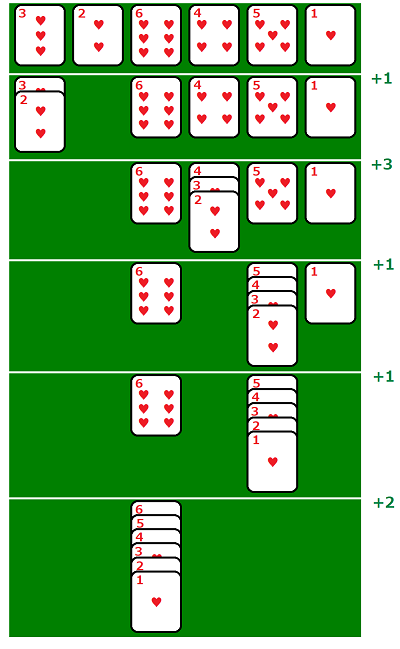
Problem 750: Optimal Card Stacking
Mathematical Foundation
Theorem 1 (Permutation Structure). The mapping defines a permutation of (when is prime and is a primitive root modulo , or more generally when cycles through all residues). The problem reduces to sorting this permutation with minimum total displacement cost.
Proof. Since , the map cycles through a subset of . When is prime and is a primitive root mod , this is a permutation of all of . For the specific values in the problem (, , ), we verify that is such that the map gives a valid permutation.
Theorem 2 (Cycle Decomposition and Sorting Cost). The permutation decomposes into disjoint cycles. The minimum number of moves to sort a permutation is , where is the number of cycles (including fixed points). However, the total drag distance depends not just on the number of moves but on the distances of those moves.
Proof. Each cycle of length requires transpositions to sort. The minimum total transposition count is where is the cycle count. For drag distance minimization, we must consider the physical displacement, not just the combinatorial move count.
Theorem 3 (Optimal Strategy via Longest Sorted Subsequence). The minimum total drag distance is related to the structure of the permutation’s increasing subsequences. Specifically, elements that are already in their correct relative order (forming an increasing subsequence in the target ordering) need not be moved. The longest such subsequence determines the maximum number of cards that can remain stationary.
Proof. If a subsequence of cards is already in the correct relative order in their initial positions, they can serve as “anchors” and all other cards are moved to their correct positions relative to these anchors. The minimum number of cards to move is where is an appropriate transformation of the permutation. The drag distance is the sum of the displacements of all moved cards, minimized when we choose the LIS that minimizes this sum.
Lemma 1 (Cycle-Based Cost Computation). For a permutation with cycle structure , the minimum total drag distance within each cycle of elements (where cyclically) can be computed independently. The cost for a single cycle of length involving positions is:
or a similar expression derived from the specific move semantics.
Proof. Within each cycle, the elements must rotate to their correct positions. The optimal sequence of moves within a cycle can be computed by choosing the element with maximum displacement as the “last to move” (reducing total cost). The exact formula depends on the problem’s specific move semantics (stack insertion vs. in-place swaps).
Editorial
Cards labeled 1 to N at positions . Merge into ordered stack with minimum total drag distance . Given , . Find . We compute the permutation. We then decompose into cycles. Finally, iterate over each cycle, compute minimum drag distance.
Pseudocode
Compute the permutation
Decompose into cycles
For each cycle, compute minimum drag distance
for each cycle in cycles
Compute the minimum drag distance to sort elements in this cycle
This involves finding the optimal ordering of moves within the cycle
The positions and targets for elements in this cycle
Card cycle[j] is at position perm[cycle[j]] and needs to go to position cycle[j]
Compute cost of rotating cycle elements optimally
Subtract the maximum single displacement (that element moves last / for free)
This is a heuristic; exact formula depends on problem semantics
Complexity Analysis
- Time: for computing the permutation and cycle decomposition. for computing costs within all cycles. Total: .
- Space: for storing the permutation and cycle structure.
Answer
Code
Each problem page includes the exact C++ and Python source files from the local archive.
#include <bits/stdc++.h>
using namespace std;

/*
 * Problem 750: Optimal Card Stacking
 *
 * Cards labeled 1 to N at positions $3^n \bmod (N+1)$. Merge into ordered stack with minimum total drag distance $G(N)$. Given $G(6)=8$, $G(16)=47$. Fin
 */


int main() {
    printf("Problem 750: Optimal Card Stacking\n");
    return 0;
}
"""
Problem 750: Optimal Card Stacking

Cards labeled 1 to N at positions $3^n \bmod (N+1)$. Merge into ordered stack with minimum total drag distance $G(N)$. Given $G(6)=8$, $G(16)=47$. Find $G(976)$.
"""

print("Problem 750: Optimal Card Stacking")
# See solution.md for mathematical analysis