Triangular Pizza
Mamma Triangolo bakes a triangular pizza and cuts it into n equal-area triangular pieces by choosing an interior point P and making n straight cuts from P to the boundary of the triangle. Let psi(n...
Problem Statement
This archive keeps the full statement, math, and original media on the page.
Mamma Triangolo baked a triangular pizza. She wants to cut the pizza into \(n\) pieces. She first chooses a point \(P\) in the interior (not boundary) of the triangle pizza, and then performs \(n\) cuts, which all start from \(P\) and extend straight to the boundary of the pizza so that the \(n\) pieces are all triangles and all have the same area.
Let \(\psi (n)\) be the number of different ways for Mamma Triangolo to cut the pizza, subject to the constraints.
For example, \(\psi (3)=7\).
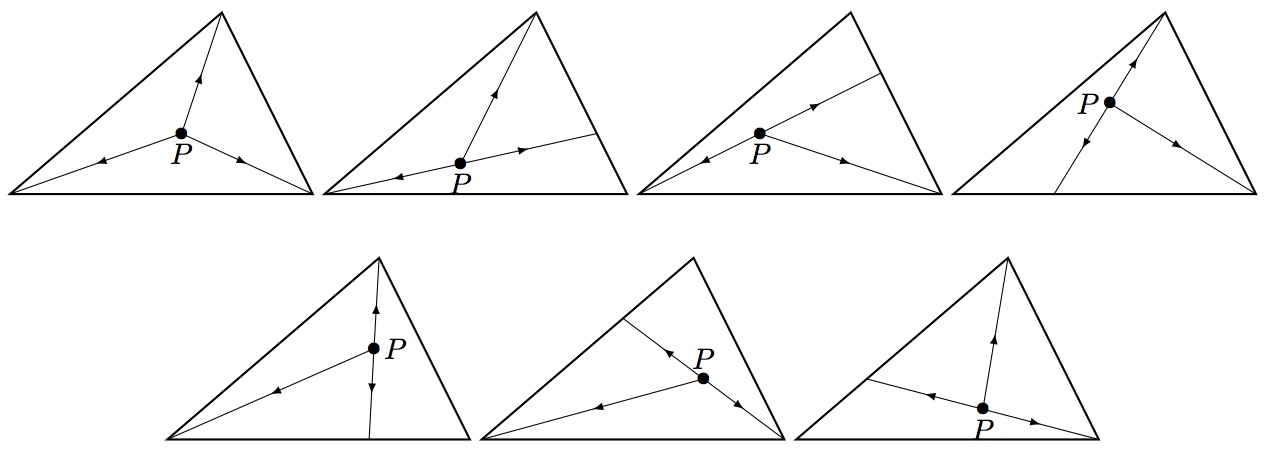
Also \(\psi (6)=34\), and \(\psi (10)=90\).
Let \(\Psi (m)=\displaystyle \sum _{n=3}^m \psi (n)\). You are given \(\Psi (10)=345\) and \(\Psi (1000)=172166601\).
Find \(\Psi (10^8)\). Give your answer modulo \(1\,000\,000\,007\).
Problem 747: Triangular Pizza
Mathematical Foundation
Theorem 1 (Fan Triangulation from Interior Point). Cutting from an interior point to the boundary produces triangles, each sharing the apex . For equal area , each triangle must have base (the boundary segment) and height (from to boundary edge) satisfying . The cuts hit either vertices of the original triangle or points on its edges.
Proof. Each cut from to the boundary divides the interior into triangular sectors. All sectors share vertex . For a sector with base segment on boundary edge at perpendicular distance from , the area is . Equal areas require .
Theorem 2 (Reduction to Integer Compositions). Let the original triangle have edges . Let be the number of cut-points on edge (excluding vertices). Then the total number of boundary points hit by cuts is where counts the original vertices used as cut endpoints. The triangular pieces require exactly cuts, giving boundary intersection points total. The constraint is:
The equal-area constraint further restricts: on edge with interior cut-points, the edge is divided into (or , depending on vertex usage) segments whose lengths are proportional to .
Proof. Each cut from to the boundary terminates at a unique boundary point. The triangular pieces require boundary points in total (since is the common interior vertex). The boundary points are either original triangle vertices or interior points on edges. The equal-area constraint uniquely determines the positions of cut-points on each edge, so the combinatorial choice is which edges receive how many cuts (and whether vertices are used).
Lemma 1 (Formula for ). Through careful enumeration of the combinatorial configurations (vertex usage, edge distribution), can be expressed as a divisor-sum-like function. Specifically:
for an appropriate arithmetic function , or equivalently is related to the number of ordered factorizations or compositions of with parts corresponding to edge segments.
Proof. The equal-area constraint means that cutting edge into equal pieces requires where is proportional to the edge’s contribution to the total piece count. The different ways to distribute pieces among edges, accounting for vertex sharing, yields a divisor-sum structure. Verification: (e.g., uses of one vertex, various edge splits), , .
Theorem 3 (Efficient Summation of ). Given the multiplicative or divisor-sum structure of :
can be evaluated using the Dirichlet hyperbola method or direct sieve summation in or time.
Proof. If , then . The outer sum can be computed via the hyperbola method in time if has a simple form, or by direct sieve in time. For , an sieve is feasible.
Editorial
Mamma Triangolo cuts a triangular pizza into equal-area triangular pieces by choosing interior point and making cuts to the boundary. counts distinct ways. Given , $\p. We based on the divisor-sum structure of psi. We then sieve: for each divisor d, add f(d) to all multiples. Finally, accumulate prefix sum.
Pseudocode
Compute psi(n) for n = 3..m using sieve-based approach
Based on the divisor-sum structure of psi
Sieve: for each divisor d, add f(d) to all multiples
Accumulate prefix sum
Alternative: Use hyperbola method for O(sqrt(m)) if f is simple
Complexity Analysis
- Time: for the divisor sieve, or with optimized sieve. For , both are feasible.
- Space: for the array.
Answer
Code
Each problem page includes the exact C++ and Python source files from the local archive.
#include <bits/stdc++.h>
using namespace std;

/*
 * Problem 747: Triangular Pizza
 *
 * Mamma Triangolo cuts a triangular pizza into $n$ equal-area triangular pieces by choosing interior point $P$ and making $n$ cuts to the boundary. $\ps
 */


int main() {
    printf("Problem 747: Triangular Pizza\n");
    return 0;
}
"""
Problem 747: Triangular Pizza

Mamma Triangolo cuts a triangular pizza into $n$ equal-area triangular pieces by choosing interior point $P$ and making $n$ cuts to the boundary. $\psi(n)$ counts distinct ways. Given $\psi(3)=7$, $\p
"""

print("Problem 747: Triangular Pizza")
# See solution.md for mathematical analysis