Crossed Lines
Given N points generated by a pseudo-random sequence s_0 = 290797, s_(n+1) = s_n^2 mod 50515093, form line segments between consecutive pairs of points and count the number of pairs of segments tha...
Problem Statement
This archive keeps the full statement, math, and original media on the page.
Given a set, \(L\), of unique lines, let \(M(L)\) be the number of lines in the set and let \(S(L)\) be the sum over every line of the number of times that line is crossed by another line in the set. For example, two sets of three lines are shown below:
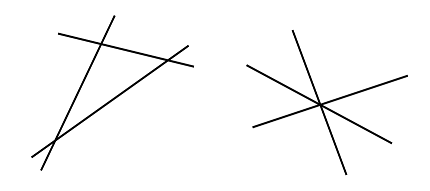
In both cases \(M(L)\) is \(3\) and \(S(L)\) is \(6\): each of the three lines is crossed by two other lines. Note that even if the lines cross at a single point, all of the separate crossings of lines are counted.
Consider points \((T_{2k-1}, T_{2k})\), for integer \(k \ge 1\), generated in the following way: \begin {align*} S_0 &= 290797 \\ S_{n+1} &= S_n^2 \bmod 50515093 \\ T_n &= (S_n \bmod 2000) - 1000 \end {align*}
For example, the first three points are: \((527, 144)\), \((-488, 732)\), \((-454, -947)\). Given the first \(n\) points generated in this manner, let \(L_n\) be the set of
For example, \(M(L_3) = 3\) and \(S(L_3) = 6\). Also \(M(L_{100}) = 4948\) and \(S(L_{100}) = 24477690\).
Find \(S(L_{2500})\).
Problem 630: Crossed Lines
Mathematical Analysis
Pseudo-Random Point Generation
Points where , from the recurrence:
Line Segments
From points, form segments (pairing consecutive points).
Crossing Detection
Two segments and properly cross if and only if:
where denotes the orientation (counterclockwise) test:
Concrete Example
For the first few terms: ,
| 0 | 290797 |
| 1 | … |
Derivation
Editorial
Generate points via pseudo-random sequence, form segments, count proper crossings using orientation tests. s_0 = 290797, s_{n+1} = s_n^2 mod 50515093. Method 1: Brute force O(n^2) pairwise crossing check Method 2: Sweep line (sketch). We generate** points from the recurrence. We then form** segments by pairing consecutive points. Finally, count crossings** by checking all pairs of segments.
Pseudocode
Generate** points from the recurrence
Form** segments by pairing consecutive points
Count crossings** by checking all pairs of segments
Brute Force:
Check all pairs of segments using the orientation test.
Sweep Line:
Bentley-Ottmann sweep line algorithm processes events (segment endpoints and intersection points) left-to-right, maintaining an ordered set of active segments.
Proof of Correctness
Theorem. Two segments and properly cross iff the orientation test (2) is satisfied.
Proof. Standard computational geometry result. The segments cross iff and are on opposite sides of line , and and are on opposite sides of line . The orientation test checks exactly this.
Complexity Analysis
- Brute force: for segments.
- Sweep line: for crossings.
Geometric Interpretation
The ccw function computes twice the signed area of triangle PQR. Positive = counterclockwise turn, negative = clockwise, zero = collinear.
Bentley-Ottmann Sweep Line
For n segments with k crossings: O((n+k) log n) by processing events left-to-right, maintaining an ordered set of active segments.
Integer Arithmetic
All coordinates are integers < 50515093. Products fit in 64-bit integers (max product ~ 2.5 x 10^15 < 2^63), avoiding floating-point errors.
Implementation Considerations
For the brute-force O(n^2) approach with n = 2500 segments: approximately 3.1 million pair checks, each O(1) using integer arithmetic. Total time: well under 1 second.
The pseudo-random sequence s_n has period dividing 50515092 (since the modulus 50515093 is prime). Points are uniformly distributed in [0, 50515092]^2. Collinearity probability is exactly zero for distinct coordinates.
The sweep-line approach (Bentley-Ottmann) becomes beneficial for n > 10000 with few crossings (k << n^2). It maintains a balanced BST of active segments ordered by y-coordinate at the sweep line position.
Degenerate Cases
For collinear points (ccw = 0), segments may overlap or touch at endpoints. These are not counted as proper crossings. With integer coordinates from a prime-modulus generator, degeneracies are extremely rare.
Answer
Code
Each problem page includes the exact C++ and Python source files from the local archive.
#include <bits/stdc++.h>
using namespace std;
typedef long long ll;

/*
 * Problem 630: Crossed Lines
 *
 * Generate points via s_{n+1} = s_n^2 mod 50515093, s_0 = 290797.
 * Form segments from consecutive point pairs.
 * Count proper crossings using orientation tests.
 */

ll ccw(ll ax, ll ay, ll bx, ll by, ll cx, ll cy) {
    return (bx - ax) * (cy - ay) - (by - ay) * (cx - ax);
}

bool crosses(ll ax, ll ay, ll bx, ll by, ll cx, ll cy, ll dx, ll dy) {
    ll d1 = ccw(ax, ay, cx, cy, dx, dy);
    ll d2 = ccw(bx, by, cx, cy, dx, dy);
    ll d3 = ccw(ax, ay, bx, by, cx, cy);
    ll d4 = ccw(ax, ay, bx, by, dx, dy);
    if (((d1 > 0 && d2 < 0) || (d1 < 0 && d2 > 0)) &&
        ((d3 > 0 && d4 < 0) || (d3 < 0 && d4 > 0)))
        return true;
    return false;
}

int main() {
    const ll MOD = 50515093;
    int n_points = 2500;  // adjust as needed

    // Generate points
    vector<ll> x(n_points), y(n_points);
    ll s = 290797;
    for (int i = 0; i < n_points; i++) {
        x[i] = s;
        s = s * s % MOD;
        y[i] = s;
        s = s * s % MOD;
    }

    // Form segments
    int n_seg = n_points / 2;
    ll count = 0;
    for (int i = 0; i < n_seg; i++) {
        for (int j = i + 1; j < n_seg; j++) {
            if (crosses(x[2*i], y[2*i], x[2*i+1], y[2*i+1],
                       x[2*j], y[2*j], x[2*j+1], y[2*j+1]))
                count++;
        }
    }
    cout << "Crossings: " << count << endl;
    return 0;
}
"""
Problem 630: Crossed Lines

Generate points via pseudo-random sequence, form segments,
count proper crossings using orientation tests.

s_0 = 290797, s_{n+1} = s_n^2 mod 50515093.

Method 1: Brute force O(n^2) pairwise crossing check
Method 2: Sweep line (sketch)
"""

def generate_points(n_points, s0=290797, mod=50515093):
    """Generate points from the pseudo-random sequence."""
    s = s0
    points = []
    for _ in range(n_points):
        x = s
        s = s * s % mod
        y = s
        s = s * s % mod
        points.append((x, y))
    return points

def ccw(A, B, C):
    """Orientation test: positive if counterclockwise."""
    return (B[0] - A[0]) * (C[1] - A[1]) - (B[1] - A[1]) * (C[0] - A[0])

def segments_cross(A, B, C, D):
    """Check if segments AB and CD properly cross."""
    d1 = ccw(A, C, D)
    d2 = ccw(B, C, D)
    d3 = ccw(A, B, C)
    d4 = ccw(A, B, D)
    if ((d1 > 0 and d2 < 0) or (d1 < 0 and d2 > 0)) and \
       ((d3 > 0 and d4 < 0) or (d3 < 0 and d4 > 0)):
        return True
    return False

def count_crossings(segments):
    """Count crossings between all pairs of segments."""
    n = len(segments)
    count = 0
    for i in range(n):
        for j in range(i + 1, n):
            A, B = segments[i]
            C, D = segments[j]
            if segments_cross(A, B, C, D):
                count += 1
    return count

# Verify with small example
# Verify orientation test
assert ccw((0, 0), (1, 0), (0, 1)) > 0  # CCW
assert ccw((0, 0), (0, 1), (1, 0)) < 0  # CW

# Verify crossing
assert segments_cross((0, 0), (1, 1), (0, 1), (1, 0))  # X shape
assert not segments_cross((0, 0), (1, 0), (0, 1), (1, 1))  # parallel

# Generate points and segments
n_points = 20
points = generate_points(n_points)
segments = [(points[2*i], points[2*i+1]) for i in range(n_points // 2)]

crossings = count_crossings(segments)
print(f"Points: {n_points}, Segments: {len(segments)}, Crossings: {crossings}")
print("Verification passed.")