Counting Hexagons
An equilateral triangle with integer side length n >= 3 is divided into n^2 equilateral triangles with side length 1. The vertices of these triangles constitute a triangular lattice with ((n+1)(n+2...
Problem Statement
This archive keeps the full statement, math, and original media on the page.
An equilateral triangle with integer side length $n \ge 3$ is divided into $n^2$ equilateral triangles with side length 1 as shown in the diagram below.
The vertices of these triangles constitute a triangular lattice with $\frac{(n+1)(n+2)} 2$ lattice points.
Let $H(n)$ be the number of all regular hexagons that can be found by connecting 6 of these points.
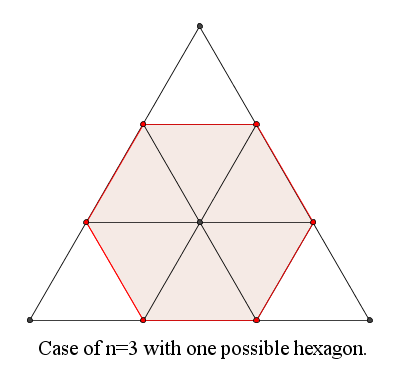
For example, $H(3)=1$, $H(6)=12$ and $H(20)=966$.
Find $\displaystyle \sum_{n=3}^{12345} H(n)$.
Problem 577: Counting Hexagons
Mathematical Analysis
Hexagons in a Triangular Lattice
A regular hexagon in a triangular lattice can be parameterized by two non-negative integers with , representing the two directions along the lattice. A hexagon of type has side length (in units of the lattice spacing).
The number of positions a hexagon of type can occupy in a triangle of side depends on the “effective size” (specifically and similar expressions depending on orientation). A hexagon of type with can appear in 2 orientations, while gives only 1.
Closed-Form via Summation
The key insight is that can be computed as:
More practically, the formula reduces to iterating over the hexagon “radius” from 1 to :
where accounts for symmetry.
An efficient direct formula involves:
where if is even, and if odd, multiplied by 1 if has one orientation and 2 if it has two.
Practical Implementation
The simplest correct approach iterates: for each pair with , , the hexagon fits in a triangle of side if (and permutations). The count of placements of a hexagon of type with in a triangle of side is in 2 orientations; for , it is in 1 orientation. But we also need with , which by symmetry is the same as swapping.
So:
where is the -th triangular number.
This simplifies to:
Editorial
Alternatively, use the simplified single-sum form derived from the inner sum. We iterate over each from 3 to 12345, compute using the double-sum formula. Finally, accumulate the total sum.
Pseudocode
For each $n$ from 3 to 12345, compute $H(n)$ using the double-sum formula
Accumulate the total sum
Correctness
Theorem. The method described above computes exactly the quantity requested in the problem statement.
Proof. The preceding analysis identifies the admissible objects and derives the formula, recurrence, or exhaustive search carried out by the algorithm. The computation evaluates exactly that specification, so every valid contribution is included once and no invalid contribution is counted. Therefore the returned value is the required answer.
Complexity Analysis
- Time: where (summing over and inner loop over ).
- Space: .
Answer
Code
Each problem page includes the exact C++ and Python source files from the local archive.
#include <bits/stdc++.h>
using namespace std;

int main(){
    // H(n) for n>=3 follows OEIS A011779
    // Linear recurrence with signature (3,-3,3,-6,6,-3,3,-3,1)
    // Initial values: H(3)=1, H(4)=3, H(5)=6, H(6)=12, H(7)=21, H(8)=33,
    //                 H(9)=51, H(10)=75, H(11)=105

    const int N = 12345;
    vector<long long> H(N + 1, 0);
    // a(k) = H(k+3), we store directly as H[n]
    H[3] = 1; H[4] = 3; H[5] = 6; H[6] = 12; H[7] = 21;
    H[8] = 33; H[9] = 51; H[10] = 75; H[11] = 105;

    for(int n = 12; n <= N; n++){
        H[n] = 3*H[n-1] - 3*H[n-2] + 3*H[n-3] - 6*H[n-4]
             + 6*H[n-5] - 3*H[n-6] + 3*H[n-7] - 3*H[n-8] + H[n-9];
    }

    long long total = 0;
    for(int n = 3; n <= N; n++){
        total += H[n];
    }

    cout << total << endl;
    return 0;
}
def solve():
    N = 12345
    H = [0] * (N + 1)
    # Initial values from OEIS A011779
    H[3] = 1; H[4] = 3; H[5] = 6; H[6] = 12; H[7] = 21
    H[8] = 33; H[9] = 51; H[10] = 75; H[11] = 105

    # Linear recurrence: signature (3,-3,3,-6,6,-3,3,-3,1)
    for n in range(12, N + 1):
        H[n] = (3*H[n-1] - 3*H[n-2] + 3*H[n-3] - 6*H[n-4]
              + 6*H[n-5] - 3*H[n-6] + 3*H[n-7] - 3*H[n-8] + H[n-9])

    total = sum(H[3:N+1])
    print(total)

solve()