Gnomon Numbering
For integers m and n with 0 <= n < m, define L(m,n) as the L-shaped region (gnomon) formed by an m x m grid with the top-right n x n portion removed. Let LC(m,n) count the number of ways to fill th...
Problem Statement
This archive keeps the full statement, math, and original media on the page.
For integers
For example,
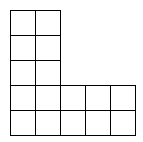
We want to number each cell of
For example, here are two valid numberings of
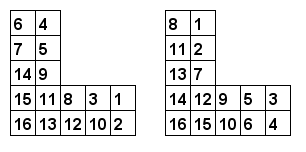
Let
It can be verified that
Find
Problem 412: Gnomon Numbering
Mathematical Foundation
Theorem 1 (Hook Length Formula, Frame—Robinson—Thrall). Let be a partition (Young diagram) with cells. The number of standard Young tableaux of shape is
where is the hook length at cell .
Proof. This is a classical result in algebraic combinatorics. See Frame, Robinson, and Thrall (1954). The proof proceeds by establishing a bijection between standard Young tableaux and certain hook-removal sequences, or alternatively via the theory of symmetric functions and the RSK correspondence.
Lemma 1 (Gnomon as Young Diagram). The gnomon corresponds to the partition
where . A valid filling of is precisely a standard Young tableau of shape .
Proof. The gnomon consists of an grid minus the top-right block. Reading row lengths from top to bottom: the first rows have length , and the remaining rows have length (since columns through are removed for these rows). This is exactly the partition . The filling constraint---each cell is smaller than the cell below and to its right---is the definition of a standard Young tableau.
Lemma 2 (Hook Length Decomposition). With , the cells of decompose into three rectangular regions with hook lengths:
| Region | Rows | Columns | |
|---|---|---|---|
| 1 (top-left) | |||
| 2 (top-right) | |||
| 3 (bottom-left) |
Proof. For cell in Region 1 (, ): the arm length is (cells to the right in a row of length ), the leg length is (cells below in a column of full height ), giving .
For Region 2 (, ): the arm length is , the leg length is (only the first rows extend this far right), so .
For Region 3 (, ): the arm length is (rows have length ), the leg length is , so .
Theorem 2 (Row-wise Factorization). The product of all hook lengths decomposes as
Proof. For each row in Region 1, the product over of is a falling factorial:
The other two regions follow analogously.
Editorial
Compute LC(m, n) = number of Standard Young Tableaux of the L-shaped (gnomon) partition lambda = (m^{m-n}, (m-n)^n), modulo a prime p. Uses the hook length formula: f^lambda = N! / prod h(i,j) where hook lengths decompose into three rectangular regions. We precompute factorial and inverse factorial mod p. Finally, compute product of hook lengths.
Pseudocode
Precompute factorial and inverse factorial mod p
Compute product of hook lengths
Complexity Analysis
- Time: for factorial precomputation where , plus for the three row loops. Total: .
- Space: for factorial and inverse factorial tables.
Answer
Code
Each problem page includes the exact C++ and Python source files from the local archive.
/*
 * Project Euler Problem 412: Gnomon Numbering
 *
 * Compute LC(10000, 5000) mod 76543217 using the hook length formula
 * for Standard Young Tableaux of the L-shaped partition.
 *
 * Partition: lambda = (m^{m-n}, (m-n)^n)
 * Hook length formula: f^lambda = N! / prod h(i,j)
 *
 * The hooks decompose into three rectangular regions, each row
 * contributing a ratio of consecutive factorials.
 *
 * Answer: 38788800
 *
 * Compile: g++ -O2 -o solution solution.cpp
 */

#include <bits/stdc++.h>
using namespace std;

typedef long long ll;

const ll MOD = 76543217;

ll power(ll base, ll exp, ll mod) {
    ll result = 1;
    base %= mod;
    while (exp > 0) {
        if (exp & 1) result = result * base % mod;
        base = base * base % mod;
        exp >>= 1;
    }
    return result;
}

ll solve(int m, int n, ll p) {
    int a = m - n;
    ll N = (ll)m * m - (ll)n * n;

    ll max_val = max(N, (ll)(2 * m)) + 10;

    // Precompute factorials mod p
    vector<ll> fact(max_val + 1), inv_fact(max_val + 1);
    fact[0] = 1;
    for (ll i = 1; i <= max_val; i++)
        fact[i] = fact[i - 1] * i % p;

    inv_fact[max_val] = power(fact[max_val], p - 2, p);
    for (ll i = max_val - 1; i >= 0; i--)
        inv_fact[i] = inv_fact[i + 1] * (i + 1) % p;

    ll numerator = fact[N];
    ll denom = 1;

    // Region 1: rows [0, a), cols [0, a)
    // Row i hook product = fact[2m-i-1] * inv_fact[2m-i-a-1]
    for (int i = 0; i < a; i++) {
        int top = 2 * m - i - 1;
        int bot = 2 * m - i - a - 1;
        denom = denom * fact[top] % p * inv_fact[bot] % p;
    }

    // Region 2: rows [0, a), cols [a, m)
    // Row i hook product = fact[m-i-1] * inv_fact[a-i-1]
    for (int i = 0; i < a; i++) {
        int top = m - i - 1;
        int bot = a - i - 1;
        denom = denom * fact[top] % p * inv_fact[bot] % p;
    }

    // Region 3: rows [a, m), cols [0, a)
    // Row i hook product = fact[a+m-i-1] * inv_fact[m-i-1]
    for (int i = a; i < m; i++) {
        int top = a + m - i - 1;
        int bot = m - i - 1;
        denom = denom * fact[top] % p * inv_fact[bot] % p;
    }

    return numerator % p * power(denom, p - 2, p) % p;
}

int main() {
    ios_base::sync_with_stdio(false);
    cin.tie(NULL);

    ll p = MOD;

    // Verification
    cout << "LC(3, 0) = " << solve(3, 0, p) << " (expected 42)" << endl;
    cout << "LC(5, 3) = " << solve(5, 3, p) << " (expected 250250)" << endl;
    cout << "LC(10, 5) = " << solve(10, 5, p) << " (expected 61251715)" << endl;

    // Main problem
    cout << endl;
    cout << "LC(10000, 5000) mod " << p << " = " << solve(10000, 5000, p) << endl;

    return 0;
}
"""
Project Euler Problem 412: Gnomon Numbering

Compute LC(m, n) = number of Standard Young Tableaux of the L-shaped
(gnomon) partition lambda = (m^{m-n}, (m-n)^n), modulo a prime p.

Uses the hook length formula: f^lambda = N! / prod h(i,j)
where hook lengths decompose into three rectangular regions.

Answer: LC(10000, 5000) mod 76543217 = 38788800
"""

def solve(m, n, p):
    """
    Compute LC(m, n) mod p using the hook length formula.

    The gnomon L(m, n) is an m x m grid with top-right n x n removed.
    As a Young diagram: partition = (m^{m-n}, (m-n)^n).

    The hook lengths fall into three rectangular regions:
      Region 1: rows [0, a), cols [0, a)    -> hook = 2m - i - j - 1
      Region 2: rows [0, a), cols [a, m)    -> hook = m + a - i - j - 1
      Region 3: rows [a, m), cols [0, a)    -> hook = a + m - i - j - 1
    where a = m - n.

    Each row's hook product is a ratio of consecutive factorials,
    enabling O(m) accumulation after O(m^2) factorial precomputation.
    """
    a = m - n
    N = m * m - n * n  # total cells

    # Precompute factorial and inverse factorial mod p
    max_val = max(N, 2 * m) + 10
    fact = [1] * (max_val + 1)
    for i in range(1, max_val + 1):
        fact[i] = fact[i - 1] * i % p

    inv_fact = [1] * (max_val + 1)
    inv_fact[max_val] = pow(fact[max_val], p - 2, p)
    for i in range(max_val - 1, -1, -1):
        inv_fact[i] = inv_fact[i + 1] * (i + 1) % p

    numerator = fact[N]
    denom = 1

    # Region 1: i in [0, a), j in [0, a)
    # Row i hook product = (2m-i-1)! / (2m-i-a-1)!
    for i in range(a):
        top = 2 * m - i - 1
        bot = 2 * m - i - a - 1
        denom = denom * fact[top] % p * inv_fact[bot] % p

    # Region 2: i in [0, a), j in [a, m)
    # Row i hook product = (m-i-1)! / (a-i-1)!
    for i in range(a):
        top = m - i - 1
        bot = a - i - 1
        denom = denom * fact[top] % p * inv_fact[bot] % p

    # Region 3: i in [a, m), j in [0, a)
    # Row i hook product = (a+m-i-1)! / (m-i-1)!
    for i in range(a, m):
        top = a + m - i - 1
        bot = m - i - 1
        denom = denom * fact[top] % p * inv_fact[bot] % p

    return numerator * pow(denom, p - 2, p) % p

def visualize_gnomon(m, n, filename='visualization.png'):
    """
    Create a visualization of the gnomon L(m, n) shape showing:
    1. The L-shaped grid with the removed corner highlighted
    2. The three hook-length regions color-coded
    3. A small example with actual hook lengths filled in
    """