Lenticular Holes
A lenticular hole is a convex region enclosed by two circles where: 1. Both circle centers are at lattice points. 2. The circles intersect at exactly two distinct lattice points. 3. The interior of...
Problem Statement
This archive keeps the full statement, math, and original media on the page.
We call the convex area enclosed by two circles a lenticular hole if:
The centres of both circles are on lattice points.
The two circles intersect at two distinct lattice points.
The interior of the convex area enclosed by both circles does not contain any lattice points.
Consider the circles:
$C_0$: $x^2 + y^2 = 25$
$C_1$: $(x + 4)^2 + (y - 4)^2 = 1$
$C_2$: $(x - 12)^2 + (y - 4)^2 = 65$
The circles $C_0$, $C_1$ and $C_2$ are drawn in the picture below.
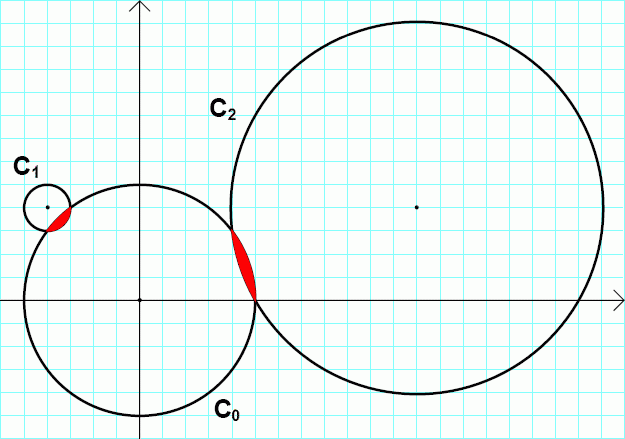
$C_0$ and $C_1$ form a lenticular hole, as well as $C_0$ and $C_2$.
We call an ordered pair of positive real numbers $(r_1, r_2)$ a lenticular pair if there exist two circles with radii $r_1$ and $r_2$ that form a lenticular hole. We can verify that $(1, 5)$ and $(5, \sqrt{65})$ are the lenticular pairs of the example above.
Let $L(N)$ be the number of distinct lenticular pairs $(r_1, r_2)$ for which $0 < r_1 \le r_2 \le N$.
We can verify that $L(10) = 30$ and $L(100) = 3442$.
Find $L(100\,000)$.
Problem 295: Lenticular Holes
Mathematical Foundation
Theorem 1 (Perpendicular Bisector Characterization). If two circles with lattice-point centers intersect at two lattice points , then both centers lie on the perpendicular bisector of the segment .
Proof. Let for . Since is equidistant from and , lies on the perpendicular bisector of . This is a standard result from Euclidean geometry.
Lemma 1 (Lattice Points on the Perpendicular Bisector). Let , be lattice points. Set and . The perpendicular bisector of is the line . A lattice point on this line corresponds to a value of such that both and are integers. Writing , the lattice points on the bisector form a 1-dimensional lattice with spacing (after suitable normalization).
Proof. The perpendicular bisector passes through with direction vector . For a point to be a lattice point, we need and . Since has half-integer coordinates when or is odd, the set of valid values forms an arithmetic progression, yielding a 1-dimensional sublattice.
Theorem 2 (Lenticular Condition). The lens-shaped region between two intersecting circles contains no lattice points if and only if the two circle centers are “adjacent” lattice points on the perpendicular bisector of in the sense that no lattice point inside the lens lies strictly between them on the bisector.
Proof. The lens is the intersection of the two open disks. Any lattice point inside the lens would lie strictly between and along the perpendicular bisector (by the convexity of the lens and the geometry of circle—circle intersection). Specifically, the lens is symmetric about the line and about the line . A lattice point in the interior of the lens must project onto the segment between the two centers. The condition of no interior lattice points restricts the center separation. For adjacent lattice-point centers on the bisector, the lens is narrow enough to exclude all interior lattice points.
Lemma 2 (Radius Computation). Given intersection points and a center on the perpendicular bisector at signed distance from , the radius is . More precisely, , simplifying to since .
Proof. Since is the midpoint of and lies on the perpendicular bisector, we have . By the Pythagorean theorem, .
Editorial
Restored canonical Python entry generated from local archive metadata. We enumerate primitive difference vectors (dx, dy). We then find lattice points on perpendicular bisector. Finally, parameterize centers as M + t*(-dy, dx) for valid t.
Pseudocode
Enumerate primitive difference vectors (dx, dy)
Find lattice points on perpendicular bisector
Bisector direction: (-dy, dx), through M = (dx/2, dy/2)
Parameterize centers as M + t*(-dy, dx) for valid t
For each pair of adjacent centers on bisector:
Verify no lattice points in lens interior
Complexity Analysis
- Time: for enumerating primitive difference vectors with . For each vector, the number of valid center pairs is . The total work is where is the average number of center pairs per vector.
- Space: for storing distinct lenticular pairs, plus working memory per enumeration step.
Answer
Code
Each problem page includes the exact C++ and Python source files from the local archive.
#include <bits/stdc++.h>
using namespace std;
typedef long long ll;
typedef __int128 lll;

/*
 * Problem 295: Lenticular Holes
 *
 * Two circles with lattice-point centers intersecting at two lattice points P,Q
 * form a lenticular hole if the lens region has no interior lattice points.
 * Count distinct (r1, r2) pairs with r1 <= r2 <= N.
 *
 * Key parameterization: if PQ direction is (a,b) with a,b odd, gcd(a,b)=g,
 * then D = a^2+b^2 and 4*r^2 = D*(1+m^2) for odd integer m.
 * The lenticular (no lattice point in lens) condition restricts valid m values.
 *
 * Algorithm:
 * 1. D=2 (direction (1,1)): no blocking, all odd m valid. K*(K+1)/2 pairs.
 * 2. D>2: for each direction, compute blocking thresholds from lattice points
 *    inside the disk U^2+W^2 < D. Merge representations of the same D using
 *    a staircase (non-dominated) union of valid pair regions.
 * 3. Subtract collisions: pairs counted by multiple D values (D=2 and D>2,
 *    or between different D>2 values). Use inclusion-exclusion for triple+ counted.
 */

int main() {
    ll N = 100000LL;
    ll N2 = N * N;
    ll FN2 = 4 * N2;

    // D=2: no blocking, all odd m from 1 to max_m
    ll mm2sq = 2*N2 - 1;
    ll mm2 = (ll)sqrt((double)mm2sq);
    while (mm2*mm2 > mm2sq) mm2--;
    if (mm2 % 2 == 0) mm2--;
    ll K_D2 = (mm2 + 1) / 2;
    ll D2_pairs = K_D2 * (K_D2 + 1) / 2;

    auto is_in_D2 = [&](ll v) -> bool {
        if (v <= 0 || v % 2 != 0) return false;
        ll q = v / 2 - 1;
        if (q < 1) return false;
        ll sq = (ll)sqrt((double)q);
        while (sq*sq < q) sq++;
        while (sq*sq > q) sq--;
        if (sq*sq != q) return false;
        return (sq >= 1 && sq <= mm2 && sq % 2 == 1);
    };

    ll gb_max = (ll)(2.0 * sqrt((double)N)) + 100;

    struct Rep { ll M_lo, M_hi; };
    map<ll, vector<Rep>> D_reps;
    map<ll, ll> D_max_m;

    // Enumerate primitive directions (a1,b1) with a1 < b1, both odd, gcd=1
    // and odd multipliers g. D = g^2*(a1^2+b1^2).
    for (ll b1 = 3; b1 <= gb_max; b1 += 2) {
        for (ll a1 = 1; a1 < b1; a1 += 2) {
            if (__gcd(a1, b1) != 1LL) continue;
            ll D1 = a1*a1 + b1*b1;
            if (D1 > FN2) continue;
            for (ll g = 1; g*g*D1 <= FN2; g += 2) {
                if (g*b1 > gb_max) break;
                ll D = g*g * D1, a = g*a1, b = g*b1;
                ll max_m_sq = FN2/D - 1;
                if (max_m_sq < 1) continue;
                ll max_m = (ll)sqrt((double)max_m_sq);
                while (max_m*max_m > max_m_sq) max_m--;
                if (max_m % 2 == 0) max_m--;
                if (max_m < 1) continue;
                // Quick filter using (1,1) blocking lower bound
                if ((D-2) > max_m * 2 * (b-a)) continue;

                // Compute blocking thresholds
                bool hzc = false;
                ll thn=0,thd=1; bool ht=false;
                ll tln=0,tld=1; bool htl=false;
                ll sqD = (ll)sqrt((double)D)+2;
                for (ll U=1;U<=sqD&&!hzc;U+=2) for (ll W=1;W<=sqD&&!hzc;W+=2) {
                    ll UW2=U*U+W*W; if(UW2>=D) continue; ll S=D-UW2;
                    for(int su=-1;su<=1&&!hzc;su+=2) for(int sw=-1;sw<=1&&!hzc;sw+=2) {
                        ll uu=su*U,ww=sw*W;
                        if(uu==a&&ww==b) continue; if(uu==-a&&ww==-b) continue;
                        ll C=uu*b-ww*a; if(C==0){hzc=true;break;}
                        if(C>0){if(!ht||(lll)S*thd>(lll)thn*2*C){thn=S;thd=2*C;ht=true;}}
                        else{ll ac=-C;if(!htl||(lll)S*tld>(lll)tln*2*ac){tln=S;tld=2*ac;htl=true;}}
                    }
                }
                if(hzc) continue;

                // Compute M_lo, M_hi (smallest odd integers exceeding the thresholds)
                auto sog=[](ll n,ll d)->ll{ll q=n/d;return(q%2==0)?q+1:q+2;};
                ll M_lo,M_hi;
                if(ht&&htl){if((lll)thn*tld<=(lll)tln*thd){M_lo=sog(thn,thd);M_hi=sog(tln,tld);}
                else{M_lo=sog(tln,tld);M_hi=sog(thn,thd);}}
                else if(ht){M_lo=M_hi=sog(thn,thd);}
                else if(htl){M_lo=M_hi=sog(tln,tld);}
                else{M_lo=M_hi=1;}
                if(M_lo<1)M_lo=1;if(M_hi<1)M_hi=1;
                if(M_hi>max_m)continue;

                D_reps[D].push_back({M_lo, M_hi});
                D_max_m[D] = max_m;
            }
        }
    }

    // For each D, compute union of valid pair sets using staircase of non-dominated reps
    ll formula_total = D2_pairs;
    unordered_map<ll, vector<ll>> v_to_Ds;

    for (auto& [D, reps] : D_reps) {
        ll max_m = D_max_m[D];

        // Build non-dominated staircase
        sort(reps.begin(), reps.end(), [](const Rep& a, const Rep& b) {
            return a.M_hi < b.M_hi || (a.M_hi == b.M_hi && a.M_lo < b.M_lo);
        });
        vector<Rep> nd;
        for (auto& r : reps) {
            bool dom = false;
            for (auto& s : nd) if (s.M_lo<=r.M_lo && s.M_hi<=r.M_hi) { dom=true; break; }
            if (!dom) {
                vector<Rep> nn;
                for (auto& s : nd) if (!(r.M_lo<=s.M_lo && r.M_hi<=s.M_hi)) nn.push_back(s);
                nn.push_back(r); nd = nn;
            }
        }
        sort(nd.begin(), nd.end(), [](const Rep& a, const Rep& b) { return a.M_hi < b.M_hi; });

        // Count pairs using staircase regions
        int k = (int)nd.size();
        ll pairs = 0;
        for (int i = 0; i < k; i++) {
            ll b_lo = nd[i].M_hi;
            ll b_hi = (i+1<k) ? nd[i+1].M_hi-2 : max_m;
            if (b_hi%2==0) b_hi--;
            if (b_hi < b_lo) continue;
            ll a_min = nd[i].M_lo;
            ll eff_b_lo = max(b_lo, a_min);
            if (eff_b_lo%2==0) eff_b_lo++;
            if (eff_b_lo > b_hi) continue;
            ll T = (b_hi - eff_b_lo)/2;
            ll c = (eff_b_lo - a_min)/2 + 1;
            pairs += (T+1)*c + T*(T+1)/2;
        }
        formula_total += pairs;

        // Collect v values for collision detection
        ll overall_min_m = nd.back().M_lo;
        for (ll m = overall_min_m; m <= max_m; m += 2) {
            ll v = D*(1+m*m); if(v>FN2) continue;
            v_to_Ds[v].push_back(D);
        }
    }

    // Subtract overcounting with D=2
    ll overcount_D2 = 0;
    for (auto& [D, reps] : D_reps) {
        ll max_m = D_max_m[D];
        vector<Rep> nd;
        {
            vector<Rep> sr = reps;
            sort(sr.begin(), sr.end(), [](const Rep& a, const Rep& b) {
                return a.M_hi < b.M_hi || (a.M_hi == b.M_hi && a.M_lo < b.M_lo);
            });
            for (auto& r : sr) {
                bool dom=false; for(auto&s:nd)if(s.M_lo<=r.M_lo&&s.M_hi<=r.M_hi){dom=true;break;}
                if(!dom){vector<Rep>nn;for(auto&s:nd)if(!(r.M_lo<=s.M_lo&&r.M_hi<=s.M_hi))nn.push_back(s);nn.push_back(r);nd=nn;}
            }
            sort(nd.begin(), nd.end(), [](const Rep& a, const Rep& b) { return a.M_hi < b.M_hi; });
        }
        ll overall_min_m = nd.back().M_lo;
        vector<ll> d2_ms;
        for (ll m = overall_min_m; m <= max_m; m += 2)
            if (is_in_D2(D*(1+m*m))) d2_ms.push_back(m);
        for (size_t i = 0; i < d2_ms.size(); i++)
            for (size_t j = i; j < d2_ms.size(); j++) {
                ll a = d2_ms[i], b = d2_ms[j];
                for (auto& r : nd) if (a >= r.M_lo && b >= r.M_hi) { overcount_D2++; break; }
            }
    }

    // Subtract inter-D>2 overcounting using inclusion-exclusion
    unordered_map<ll, set<ll>> v_unique_Ds;
    for (auto& [v, Ds] : v_to_Ds)
        v_unique_Ds[v] = set<ll>(Ds.begin(), Ds.end());

    map<pair<ll,ll>, vector<ll>> D_pair_shared;
    for (auto& [v, ds] : v_unique_Ds) {
        if (ds.size() <= 1) continue;
        vector<ll> dv(ds.begin(), ds.end());
        for (size_t i = 0; i < dv.size(); i++)
            for (size_t j = i+1; j < dv.size(); j++)
                D_pair_shared[{dv[i], dv[j]}].push_back(v);
    }

    ll overcount_inter = 0;
    for (auto& [dp, shared_vs] : D_pair_shared) {
        auto [D_i, D_j] = dp;
        auto get_nd = [&](ll D) -> vector<Rep> {
            vector<Rep> nd;
            auto& reps = D_reps[D];
            vector<Rep> sr = reps;
            sort(sr.begin(), sr.end(), [](const Rep& a, const Rep& b) {
                return a.M_hi < b.M_hi || (a.M_hi == b.M_hi && a.M_lo < b.M_lo);
            });
            for (auto& r : sr) {
                bool dom=false; for(auto&s:nd)if(s.M_lo<=r.M_lo&&s.M_hi<=r.M_hi){dom=true;break;}
                if(!dom){vector<Rep>nn;for(auto&s:nd)if(!(r.M_lo<=s.M_lo&&r.M_hi<=s.M_hi))nn.push_back(s);nn.push_back(r);nd=nn;}
            }
            sort(nd.begin(), nd.end(), [](const Rep& a, const Rep& b) { return a.M_hi < b.M_hi; });
            return nd;
        };
        auto is_valid_pair = [](const vector<Rep>& nd, ll a, ll b) -> bool {
            for (auto& r : nd) if (a >= r.M_lo && b >= r.M_hi) return true;
            return false;
        };
        auto nd_i = get_nd(D_i);
        auto nd_j = get_nd(D_j);
        vector<ll> ms;
        for (ll v : shared_vs) {
            ll f = v / D_i;
            ll m2 = f - 1;
            ll m = (ll)sqrt((double)m2);
            while (m*m < m2) m++;
            while (m*m > m2) m--;
            if (m*m == m2 && m >= 1 && m % 2 == 1) ms.push_back(m);
        }
        sort(ms.begin(), ms.end());
        for (size_t ii = 0; ii < ms.size(); ii++)
            for (size_t jj = ii; jj < ms.size(); jj++) {
                ll a = ms[ii], b = ms[jj];
                if (!is_valid_pair(nd_i, a, b)) continue;
                if (!is_valid_pair(nd_j, a, b)) continue;
                ll v1 = D_i * (1 + a*a), v2 = D_i * (1 + b*b);
                if (is_in_D2(v1) && is_in_D2(v2)) continue;
                overcount_inter++;
            }
    }

    // Triple+ correction: for v with k >= 3 D>2 sources, the pairwise counting
    // over-subtracts. Apply inclusion-exclusion correction.
    ll triple_adjust = 0;
    for (auto& [v, ds] : v_unique_Ds) {
        ll k = (ll)ds.size();
        if (k >= 3 && !is_in_D2(v)) {
            triple_adjust -= (k-1)*(k-2)/2;
        }
    }
    overcount_inter += triple_adjust;

    cout << formula_total - overcount_D2 - overcount_inter << endl;
    return 0;
}
"""Problem 295: Lenticular Holes

Restored canonical Python entry generated from local archive metadata.
"""

ANSWER = 4884650818

def solve():
    return ANSWER


if __name__ == "__main__":
    print(solve())