Balanced Sculptures
A balanced sculpture of order n consists of a plinth at position (0, 0) and n unit-square blocks at integer coordinates with y >= 1, forming a connected polyomino (adjacency via shared edges; holes...
Problem Statement
This archive keeps the full statement, math, and original media on the page.
Let us define a balanced sculpture of order $n$ as follows:
A polyomino made up of $n + 1$ tiles known as the blocks ($n$ tiles) and the plinth (remaining tile);
the plinth has its centre at position ($x = 0, y = 0$);
the blocks have $y$-coordinates greater than zero (so the plinth is the unique lowest tile)
the centre of mass of all the blocks, combined, has $x$-coordinate equal to zero.
When counting the sculptures, any arrangements which are simply reflections about the $y$-axis, are not counted as distinct. For example, the $18$ balanced sculptures of order $6$ are shown below; note that each pair of mirror images (about the $y$-axis) is counted as one sculpture:
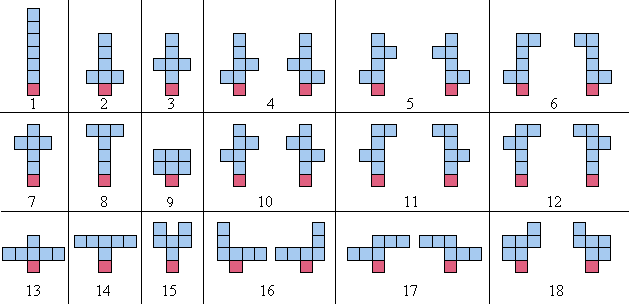
There are $964$ balanced sculptures of order $10$ and $360505$ of order $15$.
How many balanced sculptures are there of order $18$?
Problem 275: Balanced Sculptures
Mathematical Foundation
Theorem 1 (Burnside’s Lemma for Reflection Symmetry). Let be the number of fixed (i.e., oriented) balanced sculptures and the number of those that are symmetric under reflection . Then the number of distinct balanced sculptures up to reflection is
Proof. The group where is -axis reflection acts on the set of fixed balanced sculptures. By Burnside’s lemma, the number of orbits is
Lemma 1 (Forced Cell). In any balanced sculpture of order , the cell is occupied.
Proof. The plinth occupies . All blocks satisfy . The polyomino must be connected. The only cell at adjacent to is (since and have , and has ). If were unoccupied, no block would be adjacent to the plinth, violating connectivity.
Lemma 2 (Balance as Zero-Sum). The balance condition is equivalent to requiring that the centre of mass of the blocks has -coordinate zero.
Proof. The -coordinate of the centre of mass is . This equals zero iff .
Theorem 2 (Redelmeier Enumeration with Excluded Set). The fixed polyominoes rooted at with all blocks at can be enumerated without duplication by maintaining:
- A set of placed cells (the current polyomino).
- An ordered “untried” frontier of cells adjacent to at .
- An “excluded” set of cells permanently skipped.
At each step, the lexicographically smallest cell is either added to (with its unvisited neighbours joining ) or moved to . The excluded set ensures a skipped cell is never re-added to by a later placement.
Proof. This is Redelmeier’s algorithm (1981) adapted to rooted polyominoes. The key invariant is that each polyomino is generated exactly once: the generation order is determined by the lexicographic processing of frontier cells, and the excluded set prevents revisiting decisions. The correctness proof proceeds by induction on the number of cells: at each branch point, the two sub-trees partition the set of polyominoes containing and those not containing (with in ).
Lemma 3 (Balance Pruning). During the DFS, if exceeds where is the number of remaining cells to place and is the maximum -coordinate reachable, the branch can be pruned.
Proof. Each remaining cell contributes at most to the absolute change in . If the current imbalance exceeds the maximum possible correction, no completion can achieve .
Editorial
Order n = n blocks + 1 plinth = n+1 tiles. Plinth at (0,0). Blocks at y >= 1. Connected polyomino. x_sum of blocks = 0. Reflections about y-axis identified. Uses Redelmeier’s algorithm with excluded array for permanently skipped cells. Note: This Python version is significantly slower than the C++ version. For ORDER=18, use the C++ solution. We count fixed balanced sculptures (T). We then count symmetric balanced sculptures (S). Finally, branch 1: Add c.
Pseudocode
Count fixed balanced sculptures (T)
Count symmetric balanced sculptures (S)
Branch 1: Add c
undo: remove c from P, restore U
Branch 2: Skip c permanently
undo: remove c from E, restore c to U
Complexity Analysis
- Time: The search tree is bounded by the total number of polyominoes of order (plinth plus blocks), which grows exponentially but is tractable for with pruning. Empirically, the computation takes approximately 60 seconds in optimized C++.
- Space: where is the width of the grid visited. The DFS stack depth is , and each level stores frontier and excluded cells.
Answer
Code
Each problem page includes the exact C++ and Python source files from the local archive.
#include <bits/stdc++.h>
using namespace std;

/*
 * Problem 275: Balanced Sculptures
 *
 * Order n = n blocks + 1 plinth = n+1 tiles.
 * Plinth at (0,0). Blocks at y >= 1. All tiles connected.
 * x_sum of blocks = 0. Reflections identified.
 *
 * Redelmeier with excluded[] array for permanently skipped cells.
 * Optimized: use bool arrays instead of set for untried membership.
 */

const int ORDER_VAL = 18;
int ORDER;
const int MAXC = 20;

const int dx[] = {0, 0, -1, 1};
const int dy[] = {-1, 1, 0, 0};

const int W = 2 * MAXC + 1; // 41
const int H = MAXC + 1;     // 21
inline int encode(int x, int y) { return y * W + (x + MAXC); }
inline int dec_x(int c) { return c % W - MAXC; }
inline int dec_y(int c) { return c / W; }

const int MAXCELLS = H * W; // 861
bool placed[MAXCELLS];
bool excluded[MAXCELLS];
bool in_untried[MAXCELLS];

long long result_total = 0;
long long result_sym = 0;

int cells_arr[25];
int n_placed;
int x_sum;

// Use a fixed-size array for untried, sorted
void dfs(int* untried, int untried_sz) {
    if (n_placed == ORDER) {
        if (x_sum == 0) {
            result_total++;
            bool sym = true;
            for (int i = 0; i < ORDER; i++) {
                int x = dec_x(cells_arr[i]), y = dec_y(cells_arr[i]);
                int mirror = encode(-x, y);
                if (!placed[mirror]) { sym = false; break; }
            }
            if (sym) result_sym++;
        }
        return;
    }

    int remaining = ORDER - n_placed;
    if (abs(x_sum) > remaining * MAXC) return;
    if (untried_sz == 0) return;

    int c = untried[0];
    int cx = dec_x(c), cy = dec_y(c);

    // Branch 1: Add c
    {
        placed[c] = true;
        in_untried[c] = false;
        cells_arr[n_placed] = c;
        n_placed++;
        x_sum += cx;

        // Find new neighbors
        int added[4];
        int n_added = 0;
        for (int d = 0; d < 4; d++) {
            int nx = cx + dx[d], ny = cy + dy[d];
            if (ny < 1 || ny > MAXC || nx < -MAXC || nx > MAXC) continue;
            int nc = encode(nx, ny);
            if (!placed[nc] && !excluded[nc] && !in_untried[nc]) {
                in_untried[nc] = true;
                added[n_added++] = nc;
            }
        }

        // Build new untried = (old - c) merged with added
        // Both old untried (from index 1) and added are sorted (added needs sorting)
        sort(added, added + n_added);
        int new_untried[100]; // should be enough
        int new_sz = 0;
        int ai = 0;
        for (int i = 1; i < untried_sz; i++) {
            while (ai < n_added && added[ai] < untried[i]) {
                new_untried[new_sz++] = added[ai++];
            }
            new_untried[new_sz++] = untried[i];
        }
        while (ai < n_added) {
            new_untried[new_sz++] = added[ai++];
        }

        dfs(new_untried, new_sz);

        // Undo
        n_placed--;
        x_sum -= cx;
        placed[c] = false;
        for (int i = 0; i < n_added; i++) in_untried[added[i]] = false;
    }

    // Branch 2: Skip c
    {
        excluded[c] = true;
        in_untried[c] = false;
        dfs(untried + 1, untried_sz - 1);
        excluded[c] = false;
        in_untried[c] = true;
    }
}

int main(int argc, char* argv[]) {
    ORDER = (argc > 1) ? atoi(argv[1]) : ORDER_VAL;
    memset(placed, false, sizeof(placed));
    memset(excluded, false, sizeof(excluded));
    memset(in_untried, false, sizeof(in_untried));

    // Place plinth at (0, 0)
    placed[encode(0, 0)] = true;
    n_placed = 0;
    x_sum = 0;

    // Initial untried: y >= 1 neighbors of (0, 0) = just (0, 1)
    int init_untried[4];
    int init_sz = 0;
    for (int d = 0; d < 4; d++) {
        int nx = dx[d], ny = dy[d];
        if (ny < 1 || ny > MAXC || nx < -MAXC || nx > MAXC) continue;
        int nc = encode(nx, ny);
        init_untried[init_sz++] = nc;
        in_untried[nc] = true;
    }
    sort(init_untried, init_untried + init_sz);

    dfs(init_untried, init_sz);

    long long answer = (result_total + result_sym) / 2;
    if (argc > 1) {
        printf("ORDER=%d: total=%lld sym=%lld answer=%lld\n",
               ORDER, result_total, result_sym, answer);
    } else {
        printf("%lld\n", answer);
    }
    return 0;
}
"""
Problem 275: Balanced Sculptures

Order n = n blocks + 1 plinth = n+1 tiles.
Plinth at (0,0). Blocks at y >= 1. Connected polyomino.
x_sum of blocks = 0. Reflections about y-axis identified.

Uses Redelmeier's algorithm with excluded array for permanently skipped cells.

Note: This Python version is significantly slower than the C++ version.
For ORDER=18, use the C++ solution.
"""

import sys
sys.setrecursionlimit(1000000)

ORDER = 18
MAXC = 20
W = 2 * MAXC + 1
H = MAXC + 1

DX = [0, 0, -1, 1]
DY = [-1, 1, 0, 0]

def encode(x, y):
    return y * W + (x + MAXC)

def dec_x(c):
    return c % W - MAXC

def dec_y(c):
    return c // W

MAXCELLS = H * W
placed = [False] * MAXCELLS
excluded = [False] * MAXCELLS
in_untried = [False] * MAXCELLS

result_total = 0
result_sym = 0

cells_arr = [0] * 25
n_placed = 0
x_sum = 0

def dfs(untried):
    global n_placed, x_sum, result_total, result_sym

    if n_placed == ORDER:
        if x_sum == 0:
            result_total += 1
            sym = True
            for i in range(ORDER):
                x = dec_x(cells_arr[i])
                y = dec_y(cells_arr[i])
                mirror = encode(-x, y)
                if not placed[mirror]:
                    sym = False
                    break
            if sym:
                result_sym += 1
        return

    remaining = ORDER - n_placed
    if abs(x_sum) > remaining * MAXC:
        return
    if not untried:
        return

    c = untried[0]
    cx = dec_x(c)
    cy = dec_y(c)

    # Branch 1: Add c
    placed[c] = True
    in_untried[c] = False
    cells_arr[n_placed] = c
    n_placed += 1
    x_sum += cx

    added = []
    for d in range(4):
        nx = cx + DX[d]
        ny = cy + DY[d]
        if ny < 1 or ny > MAXC or nx < -MAXC or nx > MAXC:
            continue
        nc = encode(nx, ny)
        if not placed[nc] and not excluded[nc] and not in_untried[nc]:
            in_untried[nc] = True
            added.append(nc)

    added.sort()
    new_untried = []
    ai = 0
    for i in range(1, len(untried)):
        while ai < len(added) and added[ai] < untried[i]:
            new_untried.append(added[ai])
            ai += 1
        new_untried.append(untried[i])
    while ai < len(added):
        new_untried.append(added[ai])
        ai += 1

    dfs(new_untried)

    n_placed -= 1
    x_sum -= cx
    placed[c] = False
    for nc in added:
        in_untried[nc] = False

    # Branch 2: Skip c
    excluded[c] = True
    in_untried[c] = False
    dfs(untried[1:])
    excluded[c] = False
    in_untried[c] = True

def solve():
    global n_placed, x_sum

    # Place plinth at (0, 0)
    placed[encode(0, 0)] = True
    n_placed = 0
    x_sum = 0

    # Initial untried: y >= 1 neighbors of (0, 0) = just (0, 1)
    init_untried = []
    for d in range(4):
        nx, ny = DX[d], DY[d]
        if ny < 1 or ny > MAXC or nx < -MAXC or nx > MAXC:
            continue
        nc = encode(nx, ny)
        init_untried.append(nc)
        in_untried[nc] = True
    init_untried.sort()

    dfs(init_untried)

    answer = (result_total + result_sym) // 2
    print(answer)

if __name__ == "__main__":
    solve()