A Scoop of Blancmange
The Blancmange curve is blanc(x)=sum_(n=0)^infinity(s(2^n x))/(2^n), s(x)=min_(kinmathbb Z)|x-k|. Consider the circle (x-frac14)^2+(y-frac12)^2=frac116. Find the area of the region that lies both b...
Problem Statement
This archive keeps the full statement, math, and original media on the page.
The blancmange curve is the set of points $(x, y)$ such that $0 \le x \le 1$ and $\displaystyle y = \sum \limits_{n = 0}^{\infty} {\dfrac{s(2^n x)}{2^n}}$, where $s(x)$ is the distance from $x$ to the nearest integer.
The area under the blancmange curve is equal to ½, shown in pink in the diagram below.
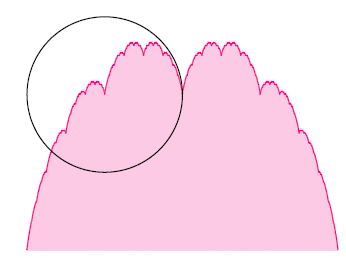
Let $C$ be the circle with centre $\left ( \frac{1}{4}, \frac{1}{2} \right )$ and radius $\frac{1}{4}$, shown in black in the diagram.
What area under the blancmange curve is enclosed by $C$?
Give your answer rounded to eight decimal places in the form $0.abcdefgh$.
Problem 226: A Scoop of Blancmange
Mathematical Development
Since , the tail of the Blancmange series is bounded by
So truncating after terms leaves an error below , which is far smaller than the required precision.
The lower arc of the circle is
The relevant intersection points satisfy
One of them is obvious:
The other lies near and is found numerically. Once that left intersection is known, the desired area is
So the whole problem reduces to two numerical tasks:
- find the left intersection accurately;
- integrate the difference between the curve and the lower arc.
Editorial
The function itself is not the obstacle. Because the Blancmange series has a geometric tail, terms already give much more accuracy than the final answer needs. That lets us treat as an ordinary smooth-enough numeric function everywhere in the relevant interval.
From there, the geometry is clean. The enclosed region starts at the nontrivial intersection of the curve with the circle, ends at , and its height is simply
So the program first locates the left intersection with a robust one-dimensional root finder, then integrates that height with Simpson’s rule on a fine grid. There is no symbolic trick after that; the important part is keeping the truncation and quadrature errors comfortably below .
Pseudocode
Approximate blanc(x) by summing the first 60 terms of the series.

Define the circle equation
    f(x) = (x - 1/4)^2 + (blanc(x) - 1/2)^2 - 1/16.

Use a bracketing root finder on the interval near 0.08
to locate the left intersection x1.

Define the lower circle arc y_low(x).
Define the integrand blanc(x) - y_low(x).

Apply Simpson's rule on [x1, 1/2] with a sufficiently fine subdivision.
Print the area to 8 decimal places.
Complexity Analysis
- Time: where Blancmange terms are evaluated at each of the quadrature points.
- Space: .
Answer
Code
Each problem page includes the exact C++ and Python source files from the local archive.
#include <bits/stdc++.h>
using namespace std;

// Triangle wave: distance to nearest integer
double s(double x) {
    return abs(x - round(x));
}

// Blancmange curve value at x (60 terms suffice for ~18 digit precision)
double blanc(double x) {
    double result = 0.0;
    double pow2 = 1.0;
    for (int n = 0; n < 60; n++) {
        result += s(pow2 * x) / pow2;
        pow2 *= 2.0;
    }
    return result;
}

// Circle: (x - 1/4)^2 + (y - 1/2)^2 = 1/16
// Lower arc: y = 1/2 - sqrt(1/16 - (x - 1/4)^2)
double circle_lower(double x) {
    double val = 1.0 / 16.0 - (x - 0.25) * (x - 0.25);
    if (val < 0) return 0.5;
    return 0.5 - sqrt(val);
}

// Function whose root gives the intersection point
double on_circle(double x) {
    double b = blanc(x);
    return (x - 0.25) * (x - 0.25) + (b - 0.5) * (b - 0.5) - 1.0 / 16.0;
}

// Brent's method to find root in [a, b]
double brent(double a, double b, double tol = 1e-15) {
    double fa = on_circle(a), fb = on_circle(b);
    if (fa * fb > 0) return a;
    double c = a, fc = fa, d = b - a, e = d;
    for (int i = 0; i < 200; i++) {
        if (fb * fc > 0) { c = a; fc = fa; d = e = b - a; }
        if (fabs(fc) < fabs(fb)) { a = b; b = c; c = a; fa = fb; fb = fc; fc = fa; }
        double tol1 = 2e-16 * fabs(b) + 0.5 * tol;
        double m = 0.5 * (c - b);
        if (fabs(m) <= tol1 || fb == 0) return b;
        if (fabs(e) >= tol1 && fabs(fa) > fabs(fb)) {
            double s_val;
            if (a == c) {
                s_val = fb / fa; double p = 2 * m * s_val; double q = 1 - s_val;
                if (p > 0) q = -q; else p = -p;
                if (2*p < 3*m*q - fabs(tol1*q) && 2*p < fabs(e*q)) { e = d; d = p/q; }
                else { d = m; e = m; }
            } else { d = m; e = m; }
        } else { d = m; e = m; }
        a = b; fa = fb;
        if (fabs(d) > tol1) b += d;
        else b += (m > 0 ? tol1 : -tol1);
        fb = on_circle(b);
    }
    return b;
}

int main() {
    // Find intersection point x1
    double x1 = brent(0.05, 0.1);
    double x2 = 0.5;

    // Integrand: blanc(x) - circle_lower(x)
    auto integrand = [](double x) -> double {
        return blanc(x) - (0.5 - sqrt(max(0.0, 1.0 / 16.0 - (x - 0.25) * (x - 0.25))));
    };

    // Simpson's rule with 2M subdivisions
    int N = 2000000;
    double h = (x2 - x1) / N;
    double sum = integrand(x1) + integrand(x2);

    for (int i = 1; i < N; i++) {
        double x = x1 + i * h;
        sum += (i % 2 == 0 ? 2.0 : 4.0) * integrand(x);
    }

    double area = sum * h / 3.0;
    printf("%.8f\n", area);
    return 0;
}
"""
Problem 226: A Scoop of Blancmange

Find the area under the Blancmange curve enclosed by the circle
(x - 1/4)^2 + (y - 1/2)^2 = 1/16, to 8 decimal places.
"""

import math

def s(x):
    """Triangle wave: distance to nearest integer."""
    return abs(x - round(x))

def blanc(x, terms=60):
    """Blancmange (Takagi) curve value at x."""
    result = 0.0
    pow2 = 1.0
    for _ in range(terms):
        result += s(pow2 * x) / pow2
        pow2 *= 2.0
    return result

def on_circle(x):
    """Returns (x-1/4)^2 + (blanc(x)-1/2)^2 - 1/16. Zero on circle."""
    b = blanc(x)
    return (x - 0.25)**2 + (b - 0.5)**2 - 1.0/16

def circle_lower(x):
    """Lower arc of circle: y = 1/2 - sqrt(1/16 - (x-1/4)^2)."""
    val = 1.0/16 - (x - 0.25)**2
    if val < 0:
        return 0.5
    return 0.5 - math.sqrt(val)

def bisect_root(f, a, b, tol=1e-14):
    """Find root of f in [a, b] using bisection."""
    fa, fb = f(a), f(b)
    if fa * fb > 0:
        return a
    for _ in range(100):
        mid = (a + b) / 2
        fm = f(mid)
        if abs(b - a) < tol:
            return mid
        if fa * fm <= 0:
            b, fb = mid, fm
        else:
            a, fa = mid, fm
    return (a + b) / 2

def integrand(x):
    """blanc(x) - circle_lower(x)"""
    return blanc(x) - circle_lower(x)

def simpsons(f, a, b, n):
    """Simpson's rule with n subdivisions (n must be even)."""
    h = (b - a) / n
    result = f(a) + f(b)
    for i in range(1, n):
        x = a + i * h
        result += (2 if i % 2 == 0 else 4) * f(x)
    return result * h / 3

def solve():
    x1 = bisect_root(on_circle, 0.05, 0.1)
    x2 = 0.5
    subdivisions = 100000
    area = simpsons(integrand, x1, x2, subdivisions)
    print(f"{area:.8f}")


if __name__ == "__main__":
    solve()