Triangles Containing the Origin
Consider all lattice points (integer coordinates) strictly inside or on the circle of radius 105 centered at the origin. How many triangles formed by three such points strictly contain the origin?
Problem Statement
This archive keeps the full statement, math, and original media on the page.
Consider the set \(I_r\) of points \((x,y)\) with integer co-ordinates in the interior of the circle with radius \(r\), centered at the origin, i.e. \(x^2 + y^2 \lt r^2\).
For a radius of \(2\), \(I_2\) contains the nine points \((0,0)\), \((1,0)\), \((1,1)\), \((0,1)\), \((-1,1)\), \((-1,0)\), \((-1,-1)\), \((0,-1)\) and \((1,-1)\). There are eight triangles having all three vertices in \(I_2\) which contain the origin in the interior. Two of them are shown below, the others are obtained from these by rotation.
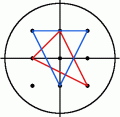
For a radius of \(3\), there are \(360\) triangles containing the origin in the interior and having all vertices in \(I_3\) and for \(I_5\) the number is \(10600\).
How many triangles are there containing the origin in the interior and having all three vertices in \(I_{105}\)?
Problem 184: Triangles Containing the Origin
Mathematical Foundation
Theorem 1. A non-degenerate triangle with vertices (none at the origin) strictly contains the origin if and only if the three vertices, viewed from the origin, do not all lie in any closed half-plane bounded by a line through the origin.
Proof. A point lies strictly inside triangle if and only if is on the same (strict) side of each of the three lines , , . Equivalently, viewing as vectors from , the angles , , (measured as arcs going around) each satisfy the condition that no semicircle contains all three points. If all three points lay in a closed half-plane, the origin would be on or outside the corresponding edge, a contradiction. Conversely, if no half-plane contains all three, the origin must be interior.
Theorem 2 (Complementary Counting). Let be the number of non-origin lattice points with . The number of triangles containing the origin equals
where is the number of points with angle strictly in (i.e., in the open semicircle starting just after point ).
Proof. A triple of non-origin points fails to contain the origin if and only if all three lie in some closed semicircle. We sort all points by their angle . For a “bad” triple lying in a semicircle, define the “first” point as the one such that proceeding counterclockwise from it, all three points fit within an arc of length . For each point , the points in the open semicircle are the candidates for the other two members of a bad triple where is first. Thus the number of bad triples is . Each bad triple is counted exactly once (by its unique “first” point in the angular sweep).
Lemma 1. For a circle of radius , the number of lattice points on or inside the circle (excluding the origin) is . The two-pointer method computes all values in time after sorting.
Proof. After sorting angles, we maintain a pointer for each marking the farthest point within the semicircle. As advances, can only advance (the semicircle window slides). Thus the total pointer movement is .
Editorial
Count triangles with integer-coordinate vertices on/inside circle of radius 105 that strictly contain the origin. Method: complementary counting with angular sweep. We collect non-origin lattice points. We then sort by angle. Finally, two-pointer sweep for semicircle counts.
Pseudocode
Collect non-origin lattice points
Sort by angle
Two-pointer sweep for semicircle counts
Complexity Analysis
- Time: for sorting, plus for the two-pointer sweep, where lattice points.
- Space: for storing points and angles.
Answer
Code
Each problem page includes the exact C++ and Python source files from the local archive.
#include <bits/stdc++.h>
using namespace std;

int main(){
    const int R = 105;
    const long long R2 = (long long)R * R;

    // Collect non-origin lattice points inside/on circle
    // We'll sort by angle using cross/dot product comparisons to avoid floating point

    // Group points by direction (reduced direction vector)
    // For the semicircle counting, we use a standard approach:
    // Sort by angle, then two-pointer

    struct Point {
        int x, y;
    };

    vector<Point> pts;
    for(int x = -R; x <= R; x++){
        for(int y = -R; y <= R; y++){
            if(x == 0 && y == 0) continue;
            if((long long)x*x + (long long)y*y <= R2){
                pts.push_back({x, y});
            }
        }
    }

    int N = pts.size();

    // Sort by angle using atan2 (careful with precision)
    // Use a comparator based on half-plane then cross product
    auto half = [](const Point& p) -> int {
        // 0 for upper half-plane (y > 0, or y == 0 && x > 0)
        // 1 for lower half-plane
        if(p.y != 0) return (p.y > 0) ? 0 : 1;
        return (p.x > 0) ? 0 : 1;
    };

    sort(pts.begin(), pts.end(), [&](const Point& a, const Point& b){
        int ha = half(a), hb = half(b);
        if(ha != hb) return ha < hb;
        long long cross = (long long)a.x * b.y - (long long)a.y * b.x;
        return cross > 0; // a before b if cross > 0 (a is counterclockwise before b)
    });

    // Two-pointer: for each point i, count points strictly in (angle_i, angle_i + pi)
    // A point j is in the open semicircle (angle_i, angle_i + pi) if:
    //   cross(i, j) > 0 (j is strictly counterclockwise from i)
    //   AND dot-check that j is not past pi from i
    // Actually: j is in (theta_i, theta_i + pi) iff
    //   cross(i, j) > 0  (strictly counterclockwise, less than pi away)

    // Duplicate the array for wraparound
    vector<Point> ext(2 * N);
    for(int i = 0; i < N; i++){
        ext[i] = pts[i];
        ext[i + N] = pts[i]; // wrapped
    }

    // cross(a, b) > 0 means b is strictly CCW from a (angle between 0 and pi)
    // cross(a, b) = 0 means collinear
    // cross(a, b) < 0 means b is CW or past pi

    // For point i, we want j such that cross(pts[i], pts[j % N]) > 0
    // This means pts[j] is in the open semicircle (theta_i, theta_i + pi)

    long long bad = 0;
    int j = 0;
    for(int i = 0; i < N; i++){
        if(j <= i) j = i + 1;
        // Advance j while cross(pts[i], ext[j]) > 0
        while(j < i + N){
            long long cross = (long long)pts[i].x * ext[j].y - (long long)pts[i].y * ext[j].x;
            if(cross <= 0) break;
            j++;
        }
        long long cnt = j - i - 1;
        bad += cnt * (cnt - 1) / 2;
    }

    long long total = (long long)N * (N - 1) * (N - 2) / 6;
    cout << total - bad << endl;

    return 0;
}
"""
Problem 184: Triangles Containing the Origin

Count triangles with integer-coordinate vertices on/inside circle of radius 105
that strictly contain the origin.

Method: complementary counting with angular sweep.
"""

def solve():
    R = 105
    R2 = R * R

    # Collect non-origin lattice points
    pts = []
    for x in range(-R, R + 1):
        for y in range(-R, R + 1):
            if x == 0 and y == 0:
                continue
            if x * x + y * y <= R2:
                pts.append((x, y))

    N = len(pts)

    # Sort by angle using half-plane + cross product
    def sort_key(p):
        x, y = p
        # half: 0 for upper (y>0 or y==0,x>0), 1 for lower
        if y != 0:
            h = 0 if y > 0 else 1
        else:
            h = 0 if x > 0 else 1
        return h

    # Custom sort
    from functools import cmp_to_key

    def cmp(a, b):
        ha = 0 if (a[1] > 0 or (a[1] == 0 and a[0] > 0)) else 1
        hb = 0 if (b[1] > 0 or (b[1] == 0 and b[0] > 0)) else 1
        if ha != hb:
            return -1 if ha < hb else 1
        cross = a[0] * b[1] - a[1] * b[0]
        if cross > 0:
            return -1
        elif cross < 0:
            return 1
        return 0

    pts.sort(key=cmp_to_key(cmp))

    # Two-pointer sweep
    bad = 0
    j = 0
    for i in range(N):
        if j <= i:
            j = i + 1
        while j < i + N:
            jj = j % N
            cross = pts[i][0] * pts[jj][1] - pts[i][1] * pts[jj][0]
            if cross <= 0:
                break
            j += 1
        cnt = j - i - 1
        bad += cnt * (cnt - 1) // 2

    total = N * (N - 1) * (N - 2) // 6
    print(total - bad)

if __name__ == "__main__":
    solve()