Investigating Multiple Reflections of a Laser Beam
A laser beam enters a white cell (an ellipse defined by 4x^2 + y^2 = 100) at the point (0, 10.1) and first hits the mirror at (1.4, -9.6). Each time the beam hits the surface, it is reflected accor...
Problem Statement
This archive keeps the full statement, math, and original media on the page.
In laser physics, a "white cell" is a mirror system that acts as a delay line for the laser beam. The beam enters the cell, bounces around on the mirrors, and eventually works its way back out.
The specific white cell we will be considering is an ellipse with the equation $4x^2 + y^2 = 100$.
The section corresponding to $-0.01 \le x \le +0.01$ at the top is missing, allowing the light to enter and exit through the hole.
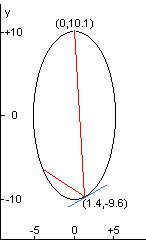

The light beam in this problem starts at the point $(0.0,10.1)$ just outside the white cell, and the beam first impacts the mirror at $(1.4,-9.6)$.
Each time the laser beam hits the surface of the ellipse, it follows the usual law of reflection "angle of incidence equals angle of reflection." That is, both the incident and reflected beams make the same angle with the normal line at the point of incidence.
In the figure on the left, the red line shows the first two points of contact between the laser beam and the wall of the white cell; the blue line shows the line tangent to the ellipse at the point of incidence of the first bounce.
The slope $m$ of the tangent line at any point $(x,y)$ of the given ellipse is: $m = -4x/y$.
The normal line is perpendicular to this tangent line at the point of incidence.
The animation on the right shows the first $10$ reflections of the beam.
How many times does the beam hit the internal surface of the white cell before exiting?
Problem 144: Investigating Multiple Reflections of a Laser Beam
Mathematical Development
Theorem 1. For the ellipse , the outward unit normal at a point on the ellipse is proportional to .
Proof. The ellipse is the level set . The gradient is perpendicular to the level curve and points outward. Simplifying by the common factor of 2:
This is outward-pointing because for a point on the ellipse with , the -component is positive (pointing away from the center).
Theorem 2 (Reflection Formula). Given an incoming direction and surface normal , the reflected direction is:
Proof. Decompose where is the component along and is tangential. The law of reflection reverses the normal component while preserving the tangential component:
Theorem 3 (Ray—Ellipse Intersection). A ray from on the ellipse in direction intersects the ellipse again at parameter:
Proof. Substitute into :
Expanding and using :
The solution corresponds to the starting point. The other solution is:
Lemma 1. The parameter in Theorem 3 is always nonzero (unless the ray is tangent to the ellipse at the starting point), so the ray always hits the ellipse again.
Proof. The numerator vanishes only when is tangent to the ellipse at . After reflection, has a nonzero normal component (since the incoming ray was not tangent), so the numerator is nonzero.
Editorial
This problem is a straight geometric simulation once the reflection formula is in place. At each impact point on the ellipse, the incoming beam direction is reflected across the normal vector . That gives the outgoing direction without ever computing angles explicitly.
After the direction has been updated, the next collision is the second intersection of the reflected ray with the ellipse. Substituting the parametric line into yields a quadratic with one root at the current point and one nonzero root at the next impact. Repeating this step advances the beam from reflection to reflection until the new point lies inside the narrow exit window near the top of the ellipse. The answer is simply the number of internal hits before that escape happens.
Pseudocode
Start from the entry point and the first point where the beam hits the ellipse.
Initialize the reflection counter to zero.

Repeat:
    Form the incoming direction from the previous point to the current one.
    Compute the surface normal $(4x,y)$ at the current impact point.
    Reflect the direction vector across that normal.

    Intersect the reflected ray with the ellipse.
    Ignore the zero root corresponding to the current point and keep the other root.
    Move to that next intersection point and increase the reflection counter.

    If the new point has positive $y$ and lies within the exit window
    $|x| \le 0.01$, stop the simulation.

Return the number of reflections performed before stopping.
Complexity Analysis
- Time: where is the number of reflections. Each reflection requires arithmetic operations (dot product, reflection, quadratic solve). Here .
- Space: — only the current position, direction, and normal need to be stored.
Answer
Code
Each problem page includes the exact C++ and Python source files from the local archive.
#include <bits/stdc++.h>
using namespace std;

int main() {
    // Problem 144: Laser reflections in ellipse 4x^2 + y^2 = 100
    // Entry: (0, 10.1) -> first hit: (1.4, -9.6)
    // Exit: |x| <= 0.01 at top (y > 0)

    double x0 = 0.0, y0 = 10.1;
    double x1 = 1.4, y1 = -9.6;

    int count = 0;

    while (true) {
        // Direction of incoming beam
        double dx = x1 - x0;
        double dy = y1 - y0;

        // Normal at (x1, y1): proportional to (4*x1, y1)
        double nx = 4.0 * x1;
        double ny = y1;

        // Reflect: d' = d - 2*(d.n)/(n.n) * n
        double dn = dx * nx + dy * ny;
        double nn = nx * nx + ny * ny;
        double rx = dx - 2.0 * dn / nn * nx;
        double ry = dy - 2.0 * dn / nn * ny;

        // Find next intersection with 4x^2 + y^2 = 100
        // Ray: (x1 + t*rx, y1 + t*ry)
        // 4(x1+t*rx)^2 + (y1+t*ry)^2 = 100
        // t * (4*rx^2 + ry^2) + 2*(4*x1*rx + y1*ry) = 0  (dividing out t=0)
        double denom = 4.0 * rx * rx + ry * ry;
        double t = -2.0 * (4.0 * x1 * rx + y1 * ry) / denom;

        double x2 = x1 + t * rx;
        double y2 = y1 + t * ry;

        count++;

        // Check exit condition
        if (fabs(x2) <= 0.01 && y2 > 0) {
            break;
        }

        x0 = x1; y0 = y1;
        x1 = x2; y1 = y2;
    }

    cout << count << endl;
    return 0;
}
"""
Problem 144: Investigating Multiple Reflections of a Laser Beam

Simulate laser reflections inside the ellipse 4x^2 + y^2 = 100.
Entry at (0, 10.1), first hit at (1.4, -9.6).
Exit when |x| <= 0.01 at the top (y > 0).
"""

def solve():
    x0, y0 = 0.0, 10.1
    x1, y1 = 1.4, -9.6

    count = 0
    points = [(x0, y0), (x1, y1)]

    while True:
        # Incoming direction
        dx = x1 - x0
        dy = y1 - y0

        # Normal at (x1, y1) on ellipse 4x^2 + y^2 = 100
        nx = 4.0 * x1
        ny = y1

        # Reflect: d' = d - 2(d.n)/(n.n) * n
        dn = dx * nx + dy * ny
        nn = nx * nx + ny * ny
        rx = dx - 2.0 * dn / nn * nx
        ry = dy - 2.0 * dn / nn * ny

        # Next intersection parameter
        denom = 4.0 * rx * rx + ry * ry
        t = -2.0 * (4.0 * x1 * rx + y1 * ry) / denom

        x2 = x1 + t * rx
        y2 = y1 + t * ry

        count += 1
        points.append((x2, y2))

        # Exit check
        if abs(x2) <= 0.01 and y2 > 0:
            break

        x0, y0 = x1, y1
        x1, y1 = x2, y2

    return count


if __name__ == "__main__":
    answer = solve()
    assert answer == 354
    print(answer)