Hexagonal Tile Differences
Hexagonal tiles are arranged in concentric rings around tile 1. For each tile n, define PD(n) as the count of differences between n and its six neighbors that are prime. Find the 2000th tile for wh...
Problem Statement
This archive keeps the full statement, math, and original media on the page.
A hexagonal tile with number $1$ is surrounded by a ring of six hexagonal tiles, starting at "12 o'clock" and numbering the tiles $2$ to $7$ in an anti-clockwise direction.
New rings are added in the same fashion, with the next rings being numbered $8$ to $19$, $20$ to $37$, $38$ to $61$, and so on. The diagram below shows the first three rings.
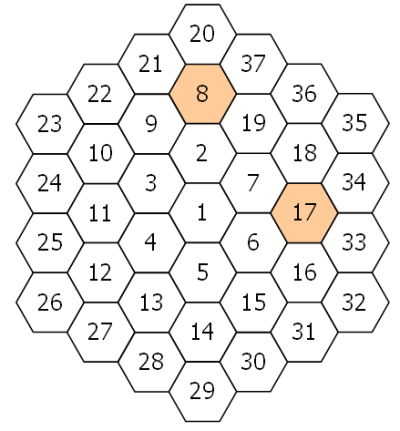
By finding the difference between tile $n$ and each of its six neighbours we shall define $\operatorname{PD}(n)$ to be the number of those differences which are prime.
For example, working clockwise around tile $8$ the differences are $12, 29, 11, 6, 1$, and $13$. So $\operatorname{PD}(8) = 3$.
In the same way, the differences around tile $17$ are $1, 17, 16, 1, 11$, and $10$, hence $\operatorname{PD}(17) = 2$.
It can be shown that the maximum value of $\operatorname{PD}(n)$ is $3$.
If all of the tiles for which $\operatorname{PD}(n) = 3$ are listed in ascending order to form a sequence, the $10$th tile would be $271$.
Find the $2000$th tile in this sequence.
Problem 128: Hexagonal Tile Differences
Mathematical Development
Definition. The hexagonal spiral has ring 0 (tile 1) at the center. Ring () contains tiles. The first tile of ring is . The last tile of ring is .
Theorem 1 (Ring formulas). The first and last tile numbers of ring are:
Proof. Ring contains tiles, and rings contain tiles. Adding the center tile (tile 1), the first tile of ring is . The last tile is .
Theorem 2 (Only endpoints have ). For , can only occur when or for some ring . Interior tiles (not at the first or last position of a ring) have .
Proof. Consider a tile at position along ring (not at a corner or endpoint). Its six neighbors include tiles from rings , , and . Among the six differences, at least four are either 1 or even numbers :
- Two adjacent tiles in the same ring give differences 1 (not prime) or small even.
- Neighbors in adjacent rings give differences that include or (both even).
Thus at most 2 differences can be prime, giving . Only the first and last tiles of each ring have a special neighbor configuration that allows exactly 3 prime differences.
Theorem 3 (Difference formulas for ). The six neighbor differences of for are: , , , , , and . Of these, only , , and can be prime. Thus if and only if all three are prime.
Proof. The neighbors of are:
- : difference 1 (not prime).
- : difference (even, for ).
- : difference (even).
- : difference .
- : difference .
- The sixth neighbor (in ring ): difference .
The values 1, , are never prime for . The remaining three (, , ) may be prime.
Theorem 4 (Difference formulas for ). For , the potentially prime differences of are , , and . Thus if and only if all three are prime.
Proof. The neighbors of are:
- (previous tile in ring): difference 1.
- : difference 1.
- : difference (even).
- : difference (even).
- Two additional neighbors yield differences , , and .
For , , so all three candidates are valid.
Lemma 1 (Tile 1). , since the neighbors of tile 1 are tiles 2—7, giving differences . The primes among these are .
Proof. Direct computation.
Editorial
The key structural fact is that almost every tile can be discarded without inspection. The only candidates for are tile 1 and the two endpoint tiles of each ring, namely the first tile and the last tile . The mathematical section reduces each of those cases to three explicit primality conditions, so the infinite spiral turns into a simple sweep over ring numbers.
The implementation seeds the count with tile 1, then walks outward ring by ring. At each ring it tests the three prime differences associated with and, for , the three associated with . Every time one of those endpoint formulas passes, another valid tile has been found; the process stops at the 2000th success.
Pseudocode
Count tile 1 as the first solution.

For ring numbers r = 1, 2, 3, ... :
    Test the three prime-difference conditions for the first tile S(r).
    If they all hold, increase the solution count and return S(r) when the target count is reached.
    If r is at least 2, test the three prime-difference conditions for the last tile E(r).
    If they all hold, increase the solution count and return E(r) when the target count is reached.
Complexity Analysis
- Time: where is the ring number of the 2000th qualifying tile and is the magnitude of the numbers tested for primality (). Each ring requires primality tests, each costing via Miller-Rabin.
- Space: (no arrays needed beyond the primality test).
Answer
Code
Each problem page includes the exact C++ and Python source files from the local archive.
#include <bits/stdc++.h>
using namespace std;

typedef long long ll;
typedef __int128 lll;

ll mulmod(ll a, ll b, ll m) {
    return (lll)a * b % m;
}

ll powmod(ll a, ll b, ll m) {
    ll res = 1;
    a %= m;
    while (b > 0) {
        if (b & 1) res = mulmod(res, a, m);
        a = mulmod(a, a, m);
        b >>= 1;
    }
    return res;
}

bool miller_rabin(ll n, ll a) {
    if (n % a == 0) return n == a;
    ll d = n - 1;
    int r = 0;
    while (d % 2 == 0) { d /= 2; r++; }
    ll x = powmod(a, d, n);
    if (x == 1 || x == n - 1) return true;
    for (int i = 0; i < r - 1; i++) {
        x = mulmod(x, x, n);
        if (x == n - 1) return true;
    }
    return false;
}

bool is_prime(ll n) {
    if (n < 2) return false;
    if (n < 4) return true;
    if (n % 2 == 0 || n % 3 == 0) return false;
    for (ll a : {2, 3, 5, 7, 11, 13, 17, 19, 23}) {
        if (!miller_rabin(n, a)) return false;
    }
    return true;
}

int main() {
    // Tile 1 is the first with PD=3.
    // For ring r >= 1:
    //   First tile S(r) = 3r(r-1)+2: check 6r-1, 6r+1, 12r+5 all prime
    //   Last tile  E(r) = 3r(r+1)+1: check 6r-1, 6r+5, 12r-7 all prime (r>=2)

    int count = 1; // tile 1
    int target = 2000;

    for (ll r = 1; ; r++) {
        // First tile of ring r
        if (is_prime(6*r - 1) && is_prime(6*r + 1) && is_prime(12*r + 5)) {
            count++;
            if (count == target) {
                cout << 3*r*(r-1) + 2 << endl;
                return 0;
            }
        }

        // Last tile of ring r (r >= 2 for 12r-7 to be > 1)
        if (r >= 2 && is_prime(6*r - 1) && is_prime(6*r + 5) && is_prime(12*r - 7)) {
            count++;
            if (count == target) {
                cout << 3*r*(r+1) + 1 << endl;
                return 0;
            }
        }
    }

    return 0;
}
"""
Problem 128: Hexagonal Tile Differences

Find the 2000th tile for which exactly 3 of the differences
with its 6 neighbors are prime.

Key insight: Only the first and last tile of each ring can have PD=3.
- First tile S(r) = 3r(r-1)+2: needs 6r-1, 6r+1, 12r+5 all prime
- Last tile  E(r) = 3r(r+1)+1: needs 6r-1, 6r+5, 12r-7 all prime (r>=2)
"""

from sympy import isprime

def solve(target=2000):
    count = 1  # tile 1 is the first with PD=3

    r = 1
    while True:
        # First tile of ring r
        if isprime(6*r - 1) and isprime(6*r + 1) and isprime(12*r + 5):
            count += 1
            if count == target:
                return 3*r*(r-1) + 2

        # Last tile of ring r (r >= 2 for 12r-7 > 1)
        if r >= 2 and isprime(6*r - 1) and isprime(6*r + 5) and isprime(12*r - 7):
            count += 1
            if count == target:
                return 3*r*(r+1) + 1

        r += 1

if __name__ == '__main__':
    answer = solve()
    print(answer)