Darts
In the game of darts, a player throws a dart at a target to score points. The board provides the following possible scores per dart: Singles: 1-20 and 25 (bull's eye outer) Doubles: D1-D20 and D25...
Problem Statement
This archive keeps the full statement, math, and original media on the page.
In the game of darts a player throws three darts at a target board which is split into twenty equal sized sections numbered one to twenty.
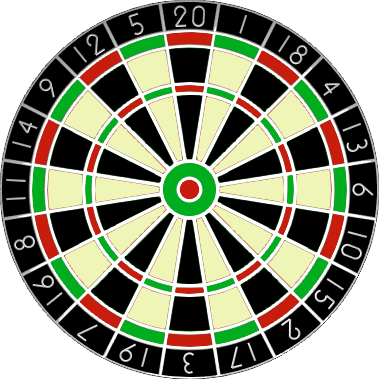
The score of a dart is determined by the number of the region that the dart lands in. A dart landing outside the red/green outer ring scores zero. The black and cream regions inside this ring represent single scores. However, the red/green outer ring and middle ring score double and treble scores respectively.
At the centre of the board are two concentric circles called the bull region, or bulls-eye. The outer bull is worth $25$ points and the inner bull is a double, worth $50$ points.
There are many variations of rules but in the most popular game the players will begin with a score 301 or 501 and the first player to reduce their running total to zero is a winner. However, it is normal to play a "doubles out" system, which means that the player must land a double (including the double bulls-eye at the centre of the board) on their final dart to win; any other dart that would reduce their running total to one or lower means the score for that set of three darts is "bust".
When a player is able to finish on their current score it is called a "checkout" and the highest checkout is $170$: $T20$ $T20$ $D25$ (two treble $20$s and double bull).
There are exactly eleven distinct ways to checkout on a score of 6:
| $D3$ | ||
| $D1$ | $D2$ | |
| $S2$ | $D2$ | |
| $D2$ | $D1$ | |
| $S4$ | $D1$ | |
| $S1$ | $S1$ | $D2$ |
| $S1$ | $T1$ | $D1$ |
| $S1$ | $S3$ | $D1$ |
| $D1$ | $D1$ | $D1$ |
| $D1$ | $S2$ | $D1$ |
| $S2$ | $S2$ | $D1$ |
Note that $D1$ $D2$ is considered different to $D2$ $D1$ as they finish on different doubles. However, the combination $S1$ $T1$ $D1$ is considered the same as $T1$ $S1$ $D1$.
In addition we shall not include misses in considering combinations; for example, $D3$ is the same as $0$ $D3$ and $0$ $0$ $D3$.
Incredibly there are 42336 distinct ways of checking out in total.
How many distinct ways can a player checkout with a score less than $100$?
Problem 109: Darts
Mathematical Foundation
Theorem 1. (Dart Score Enumeration) The set of possible scores for a single dart throw is:
- Singles: — 21 distinct darts
- Doubles: with scores — 21 distinct darts
- Trebles: with scores — 20 distinct darts
The total number of distinct dart types is .
Proof. Singles: numbers 1 through 20 (20 values) plus the outer bull 25 (1 value) = 21. Doubles: D1 through D20 (scores 2, 4, …, 40) plus D25 (score 50) = 21. Trebles: T1 through T20 (scores 3, 6, …, 60) = 20. No bull treble exists. Total = .
Theorem 2. (Checkout Count Decomposition) The total number of checkouts with score is:
where is the number of checkouts using exactly darts.
Proof. Checkouts partition by the number of darts used (1, 2, or 3). These cases are mutually exclusive and exhaustive (for checkouts, since the minimum score per dart is 1, no checkout can require more than 3 darts to achieve a score … although technically one could use fewer).
Lemma 1. (One-Dart Checkouts) .
Proof. A one-dart checkout requires the single dart to be a double with score . All 21 doubles have scores at most 50, so all qualify.
Lemma 2. (Two-Dart Checkouts) .
Proof. With 2 darts, the first dart can be any of the 62 types and the last must be a double. The order is fixed (one non-final, one final), so each pair is distinct. Count all such pairs with total score .
Lemma 3. (Three-Dart Checkouts)
where is an unordered multiset (combination with repetition).
Proof. With 3 darts, the two non-final darts are unordered. The number of unordered pairs (with repetition allowed) from 62 types is . For each such pair and each final double, count it if the total score is .
Theorem 3. (Why Unordered for Non-Final Darts) Two checkouts are considered the same if they use the same multiset of non-final darts and the same final double. The final double is distinguished by its position (last throw), but the non-final darts are not ordered.
Proof. By the problem statement, the order of non-final darts does not matter. For example, S1-T2-D3 and T2-S1-D3 are the same checkout. However, S1-D3 (as a 2-dart checkout) is different from S1-T2-D3 (3-dart checkout) even though both end with D3 — they involve different numbers of darts.
Editorial
The counting is easiest if the final dart is separated from the earlier ones. Every checkout must end with a double, so once the 62 distinct dart types have been listed, the remaining work is just a case split by the number of darts used. Distinct dart types must be kept separate even when they have the same numerical score, because for example , , and represent different checkouts.
The implementation therefore counts one-dart finishes, then two-dart finishes, and finally three-dart finishes. In the three-dart case the first two darts are treated as an unordered pair with repetition allowed, so using an index order avoids double-counting permutations of the non-final darts.
Pseudocode
List every distinct dart type together with its score, and keep a separate list of finishing doubles.
Start the checkout count at zero.

Count the one-dart finishes by scanning the doubles.
Count the two-dart finishes by pairing each dart type with each finishing double.
Count the three-dart finishes by choosing the first two darts as an unordered pair, with repetition allowed, and then appending each finishing double.

Whenever the total score is less than 100, add that checkout to the count.
Return the count.
Complexity Analysis
- Time: for the 3-dart case, which dominates. With 62 dart types and 21 doubles: iterations for the 3-dart case. The 2-dart case adds and the 1-dart case adds 21. Total: approximately operations, so in the sense that all inputs are fixed constants.
- Space: where for storing the dart list. No additional data structures needed.
Answer
Code
Each problem page includes the exact C++ and Python source files from the local archive.
#include <bits/stdc++.h>
using namespace std;

int main() {
    // Build list of all possible dart scores with labels
    // Each dart is a (score, type) pair where type is used for canonical ordering
    // We use index for canonical ordering of non-final darts

    struct Dart {
        int score;
        // For ordering: singles first, then doubles, then trebles
    };

    vector<int> all_darts;   // all 62 dart scores (with distinct identity)
    vector<int> doubles;     // double scores only

    // Singles: S1..S20, S25
    for (int i = 1; i <= 20; i++) all_darts.push_back(i);
    all_darts.push_back(25);

    // Doubles: D1..D20, D25
    for (int i = 1; i <= 20; i++) { all_darts.push_back(2*i); doubles.push_back(2*i); }
    all_darts.push_back(50); doubles.push_back(50);

    // Trebles: T1..T20
    for (int i = 1; i <= 20; i++) all_darts.push_back(3*i);

    int n = all_darts.size(); // 62
    int count = 0;

    // 1-dart checkouts: just a double < 100
    for (int d : doubles) {
        if (d < 100) count++;
    }

    // 2-dart checkouts: one non-final + one double, total < 100
    for (int i = 0; i < n; i++) {
        for (int d : doubles) {
            if (all_darts[i] + d < 100) count++;
        }
    }

    // 3-dart checkouts: two non-final (unordered, i <= j) + one double, total < 100
    for (int i = 0; i < n; i++) {
        for (int j = i; j < n; j++) {
            for (int d : doubles) {
                if (all_darts[i] + all_darts[j] + d < 100) count++;
            }
        }
    }

    cout << count << endl;
    return 0;
}
"""
Problem 109: Darts

Count distinct ways to check out (reach exactly 0) with score < 100.
Last dart must be a double. Up to 3 darts total.
Non-final darts are unordered (combinations, not permutations).
"""

def solve():
    # Build all 62 distinct darts
    # Each dart has a score and an index for canonical ordering
    all_darts = []  # (score, label) - label for identification

    # Singles: S1..S20, S25
    for i in range(1, 21):
        all_darts.append((i, f'S{i}'))
    all_darts.append((25, 'S25'))

    # Doubles: D1..D20, D25
    doubles = []
    for i in range(1, 21):
        all_darts.append((2 * i, f'D{i}'))
        doubles.append(2 * i)
    all_darts.append((50, 'D25'))
    doubles.append(50)

    # Trebles: T1..T20
    for i in range(1, 21):
        all_darts.append((3 * i, f'T{i}'))

    scores = [d[0] for d in all_darts]
    n = len(scores)  # 62

    count = 0

    # 1-dart: just a double
    for d in doubles:
        if d < 100:
            count += 1

    # 2-dart: one non-final + one final double
    for i in range(n):
        for d in doubles:
            if scores[i] + d < 100:
                count += 1

    # 3-dart: two non-final (unordered, i <= j) + one final double
    for i in range(n):
        for j in range(i, n):
            for d in doubles:
                if scores[i] + scores[j] + d < 100:
                    count += 1

    return count

answer = solve()
assert answer == 38182
print(answer)